
The next great test of democracy: governing a warming planet

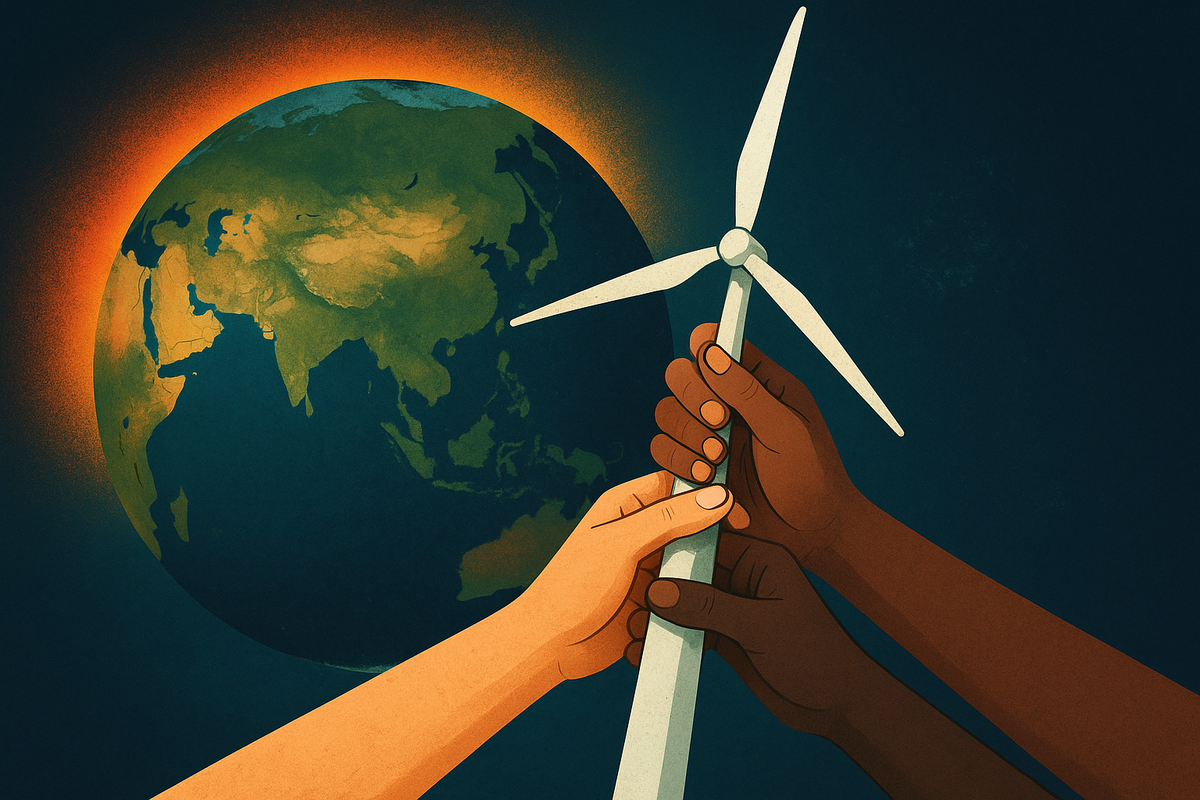
The carbon budget clock is ticking, but the story isn’t over. The question is whether our systems of governance can act on what science already knows.
Climate scientists recently issued a blunt warning: at current emission rates, the world’s remaining carbon budget for staying below 1.5 °C of warming will be gone in just two years (Global Carbon Budget 2024 – Earth System Science Data / Global Carbon Project). That threshold isn’t political, it’s simply what physics tells us, a simple measure of how much CO₂ humanity can still release before crossing a planetary boundary.
And yet, global emissions hit a record high in 2024, with governments of every kind from open democracies to centralized states remaining far from the rapid cuts science demands. The question facing all of them is the same: can their political and institutional systems translate knowledge into action quickly enough to make meaningful progress?
The paradox is striking. All political systems now face the same physics, yet open societies that pride themselves on accountability and public consent are among those struggling most to respond proportionately to a crisis they, to a reasonable extent, fully recognize. So, why is translating evidence into real action proving so difficult? And, what does this reveal about democracy’s capacity to deliver collective change when time, literally, runs out?
The two-year warning
Here’s the basic math: the carbon budget for a two-thirds chance of limiting warming to 1.5 °C now stands at roughly 80 billion tonnes CO₂. “What does that equate to?”, you may ask. Well, it’s barely two years’ worth of current emissions (Global Carbon Budget 2024/25). Beyond that, each additional tonne is likely to incur more severe climate outcomes: more heat, flooding, and displacement.
Even if we were to limit warming to 1.7 °C, this would require global emissions to fall by half within the decade. This is why scientists call the mid-2020s a “make-or-break window”: if emissions do not peak and decline sharply by 2027, the hallowed 1.5 °C will slip out of reach. Scientists note that by early 2025 global surface temperatures had already averaged around 1.47 °C above pre-industrial levels, an indication of how little margin remains, how much wiggle room we have, before the 1.5 °C line is definitively crossed.
What is undoubtedly positive is that we have such rigorously defined, clear data on this. And yet, it is the very clarity of data that poses such a direct challenge to our democracies, whose political systems are built around relatively short electoral cycles. Science works in decades; politics works in terms, and the mismatch between atmospheric deadlines and campaign calendars is where the real crisis of governance begins. In essence, the data isn’t really convenient for people and their politics.
Promises made, promises missed
Under the Paris Agreement, governments submit Nationally Determined Contributions, which are basically pledges, not mandates, to cut emissions, usually by 2030. As of this year, fewer than one-third of countries have updated their targets on schedule (UNFCCC 2025 NDCs). Even if every current pledge were kept, global emissions would fall only 10 percent by 2035, when the science calls for nearly 60 percent to be in place. The UN Secretary-General has admitted that overshooting 1.5 °C is now a virtual certainty, prompting the call for an emergency acceleration plan covering energy, transport, and agriculture, the sectors responsible for roughly 80 percent of global emissions.
So, given the obvious nature of the problem before us, we would be wise to first pinpoint the main structural hurdles democracies are facing that explain this gap between the bold, shiny rhetoric and stubborn, tarnished reality. To be blatantly reductive, there are three of these hurdles:
1. Short-term politics. Deep decarbonization often means visible costs: think higher energy prices, disrupted industries, the impossibility of grappling with the discomfort of lifestyle change. Simply put, politicians who impose those costs risk losing office. As an example, France’s 2018 fuel-tax protests and the UK’s recent delays to climate rules show how the fear of electoral risk is a swift deterrent to early action. The carbon budget, or science in general, for that matter, is apolitical, and does not wait for the next vote.
2. Entrenched interests. Democratic openness expands the avenues of possibility, and chicanery, when it comes to developing mechanisms of political persuasion, and that gives lobby groups a lot of power. Fossil-fuel and industrial lobbies have long diluted carbon pricing, delayed vehicle bans, and secured exemptions across the EU and U.S. Policy ends up an incremental afterthought, while physics still demands transformation.
3. Institutional fragmentation. Multiple veto points, which exemplify freedom of speech, yet often work exactly like roadblocks, make consensus awfully slow. Think of the courts, parliaments, federal states, all exercising legal counterattacks to those entrenched interests, based on short-termist political power thinking. Or we have an unsteady pattern, which equates to little progress: U.S. climate law has swung from Paris participation to withdrawal and back again; the Supreme Court has curtailed federal regulatory powers; while in Australia, carbon pricing vanished, then returned within a decade. Checks and balances preserve liberty, sure, but when the clock is ticking they sure do complicate continuity.
The result? A credibility deficit. Major democracies, including Japan, India, and the United States, are all off track for their own 2030 targets (Climate Action Tracker 2025). The EU has done better, which isn’t a hugely high bar, but still faces internal backsliding as energy inflation tests voter patience. Sure, a unilaterally prosecuted war in Ukraine and the ensuing pandemonium over natural gas dependency may have exacerbated things, but it all only goes to underline the fact that, when short-term pain, as evinced by the voters, collides with long-term benefit, elected leaders tend to blink.
Can democracies still deliver?
Some signs suggest that governments can rise to the challenge, especially when their institutions adapt and public energy lines up with clear policy goals. So, where are the bright spots?
Public opinion and activism. Younger voters now put climate near the top of their priorities, and they’re changing how leaders think. School-strike movements, local campaigns, and investment shifts have made climate politics harder to ignore. Politicians understand that ignoring the issue carries its own, growing, electoral risk. And as the story becomes less about sacrifice and more about the economic and societal opportunity, think jobs, cleaner air, reliable energy, the message lands better. People want progress they can see and breathe, not austerity and a sense of punishment dressed in fake green.
Institutional innovation. Some countries are already re-engineering how they make decisions. The UK’s independent Climate Change Committee, for example, sets five-year carbon budgets that stay steady beyond election cycles. Citizens’ assemblies in France, Ireland, and Germany show that when ordinary people are given facts and space to deliberate, they often back stronger action than expected. Courts are stepping in too: from the Dutch Urgenda ruling to Germany’s constitutional climate case, judges are starting to define protection of the future as a legal duty. Similar cases now span multiple regions, and this stands to turn accountability itself into a shared democratic tool.
Transparency and peer learning. Open societies can face the contortions of lobbying, but they can also benefit greatly from scrutiny. Annual “emissions gap” reports and the Paris Agreement’s Global Stocktake still show the world heading toward about 2.5 -- 2.7 °C of warming (UNEP Emissions Gap Report 2024), but they also keep the pressure on. It’s that open, visible, accessible clarity of peer-reviewed data, and the EU’s tighter 2030 target and a wave of new net-zero pledges followed that public naming. Free media and data trackers make this feedback loop hard to dodge: information moves incredibly fast, and so do the expectations that quickly accompany it.
The two-year stress test
We are now, at least, in a somewhat neat box, defined by the clear data, which tells us that by 2027 we will know whether global emissions have peaked. The imminent Brazil COP30 summit and COP31 in 2026 will both mark decisive checkpoints. And yes, we’ve heard similar rhetoric before previous COPs, with various stutters and achingly slow blips of progress that followed. Yet momentum is a fragile thing, and the return to a Republican-led U.S. presidency has emboldened climate skeptics, slowed cooperation, and led many countries to miss their 2025 pledge-update deadline (UN NDC Registry). It’s a reminder of a wider democratic vulnerability: when major powers change course, progress everywhere can stall. Too many governments still calibrate their commitment to yesterday’s hierarchy of influence, when in reality the transition will depend on a more distributed, self-reliant form of climate leadership.
Still, democracies do possess a self-correcting resilience. Australia’s 2022 election replaced an openly climate-hostile government with one that passed stronger targets within months in office. In the U.S., state-level coalitions offer realistic hope of progress, pursuing climate goals even when federal policy is reversed or outright dispensed with. This distributed form of agency, one where cities, courts, investors, and citizens act in parallel when national leadership outright abdicates its duty to the people, this is something that can sustain momentum through political turbulence. What it often lacks, however, is coordination: the shared direction that turns many local successes into a single, system-wide shift.
The scale of the task
Even democratic leaders who grasp the urgency can be stopped in their tracks by the inertia of the system. A notable example is how the EU cut overall emissions 30 percent from 1990 to 2020, mostly by phasing out heavy industry and coal in Eastern Europe. The harder sectors, such as transport, agriculture, cement, steel, are all still stubbornly high-carbon. The U.S. has flatlined emissions for a decade, while India and Indonesia are expanding renewables yet remain coal-reliant. We’ve been hearing the story for years now, so much progress in so many areas, yet in effect, global decarbonization has barely started.
What makes the challenge uniquely democratic is the tension we all feel between the present and the future: sacrifice now for benefit later. In wartime, mobilization follows a visible enemy, a story we are familiar with; in climate policy, however, the adversary is invisible until too late. The task, therefore, is to build legitimacy for preventive action. A demand not for flat obedience, something we are naturally disinclined to follow, but for a collective sense of considered and agreed consent, one grounded in trust and evidence.
Analysts estimate that meeting a 1.5 – 1.7 °C trajectory would require annual investment in clean energy to triple by 2030 while the corresponding fossil-fuel financing falls by half, a reversal that, unsurprisingly, has yet to appear in most national budgets.
Governing the Anthropocene
Sure, this line of reasoning often brings us to the question of how well democracies, with all their checks, balances, and opportunities for slow consensus, can even stand up to the test? Correspondingly, some argue that authoritarian systems act faster. China can approve a solar farm or high-speed rail line in months, while democracies deliberate for years. Lately, there are countless commentaries on the outlandish speed of progress, such as how China has put up as much solar in the last six months as the U.S. has, period. And yet, by dint of its sheer size and an export economy ironically underpinned, still, by Western appetites, China is also the world’s largest emitter, all while continuing to build new coal plants (IEA 2025 Global Energy Review).
It goes then that speed without accountability does not guarantee sustainability. Democracies, when functioning, can deliver legitimacy, transparency, and correction, all qualities essential for long-term crises. Excellent. The question, though, is whether they can compress those virtues into the timeframe physics permits.
Encouraging signs do exist. Youth climate lawsuits such as Held v. Montana in the U.S. and Duarte Agostinho v. Portugal before the European Court of Human Rights are redefining rights and showing what can happen when access to a reasonable tomorrow is elevated from abstract concepts. Parliaments from New Zealand to Finland have formed cross-party climate caucuses, and social tipping points are forming as clean-tech costs fall and renewables become a simple, expected feature of mainstream economics. The danger is complacency: confusing progress with success until reality catches up
The democratic imperative
The next two years will determine more than the planet’s temperature trajectory, they will test whether open societies can organize collective action fast enough to matter. In all likelihood, the 1.5 °C threshold will likely be exceeded, but to what degree it will be exceeded and the scale of the consequences it brings, these remain within human control.
If democracies rise to the challenge, they will prove that consent-based governance can act decisively in the long-term interest of humanity. If they fail, they will cede moral ground to those who claim that authoritarian efficiency is the only path through the crisis we are in. History would suggest that when democracies link the challenge of sacrifice to a sense of shared purpose, such as those experienced in wartime mobilization, civil-rights actions, and of course in very recent public-health campaigns, they can transform faster than experts expect. The climate emergency, and it is, demands the same fusion of urgency and legitimacy as we all experienced during the COVID-19 pandemic.
The carbon-budget countdown is thus not just a scientific deadline but a political reckoning. It asks a simple question: can democracy still keep faith with the future? If so, then it must act, in time, on what it knows to be true.
Read this. Notice that. Do something.
Read this: Pretty heavy data, but some great visualizations to help absorb it: Global Carbon Budget 2024 (ESSD / Global Carbon Project); UNFCCC NDC Registry; UNEP Emissions Gap Report 2024; IEA Global Energy Review 2025.
Notice that: democratic paralysis isn’t inevitable. independent oversight, transparent data, and civic pressure can still align near-term policy with the help of publicly accessible, open-source science.
Do something: push for 2026–2030 action plans, not fatuous 2050 slogans and treat democratic capacity itself as climate infrastructure.
Previously on GYST: Asia’s supply-chain pivot: from ASEAN enlargement to the new industrial map
Next up: The long game of small states