
The Geopolitics of Lithium: Latin America’s Defining Gamble
High in the Andes lies nearly half the world’s lithium. How Latin America manages its reserves — between global demand, local politics, and sustainability risks — will shape the energy transition and test whether resource wealth equals real power.

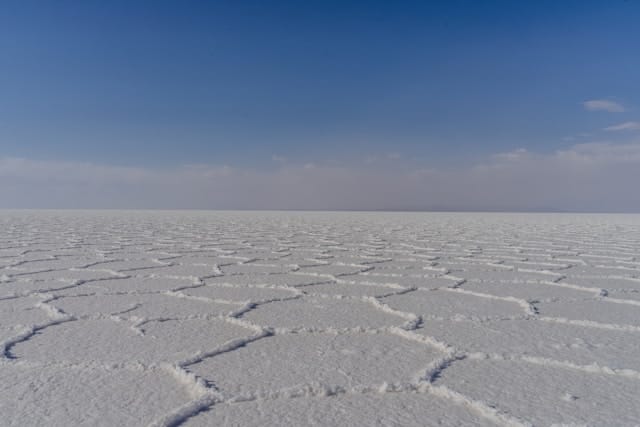
Sitting on half the world’s lithium carries considerable promise, and risk.
High in the Andes, where Argentina, Bolivia, and Chile converge, stretches a seemingly endless sea of salt flats, a desert whose crusty brines contain a decisive share of the world’s lithium. Together the three countries account for more than half of known global reserves, according to the U.S. Geological Survey’s 2025 mineral summary. From a distance the salt flats, or ‘salares’, look barren, mesmerizing plains under sharp blue sky. Up close, the windswept silence belies the fact that they are the quiet center of the global battery economy.
This land, the “lithium triangle”, has become shorthand for both enormous, glittering promise, and huge potential risk. Global demand from electric vehicles and network storage is rising fast, and lithium sits at the heart of that shift, at the heart of our practical ability to take energy and store it effectively for later use.
However, the question here is whether the triangle can turn its geological bounty into durable economic and geopolitical leverage, or whether this potential becomes another turn of a familiar wheel in Latin American history: exporting raw materials while importing dependency.
Diverging paths across the triangle
Of the triangle neighbors, Argentina is moving fastest. Installed capacity has tripled in two years as new projects have come online, according to a mid-2024 Reuters industry update. That surge is visible in the provinces of Salta and Jujuy, where joint ventures have been welcomed that marry foreign capital with local concessions. Speed, however, brings friction. In March 2024, a provincial court in Catamarca suspended new mining permits at the Salar del Hombre Muerto, pending cumulative environmental review, a signal that legal and social licenses are now hard constraints, not footnotes (Business and Human Rights Resource Centre).
Bolivia, perhaps more aspirationally, speaks about lithium as a passport to development, and its reserves in Uyuni remain iconic. Progress has, however, been halting, with successive governments promising industrialization and technology transfer; partnerships have been announced and re-announced. A long-view assessment in El País América Futura traces 17 years of promises and delays, from pilot plants to contested contracts, and captures the core problem holding Bolivia back: the difficulty in building complex industry on top of contested governance (El País).
Chile, long the regional benchmark for more proficient project governance, is reshaping its model. The Salar de Atacama remains one of the richest brines in the world, but public concern over water and consultation has slowed the path to the final rubber stamp. The government is pushing a state-led framework with private participation aimed at keeping more value at home and tightening environmental guardrails. A ground-level view from La Tercera follows Atacameño communities setting conditions on water and oversight in talks with state and corporate actors, a reminder that, in Chile at least, the social compact is being renegotiated in public (La Tercera).
Together, these paths describe a spectrum: move fast and attract capital; move deliberately to protect sovereignty; or move with a tighter public hand to balance both. None is cost-free.
The geopolitics of demand
Lithium is more than a commodity curve, it is a supply-chain map. China dominates battery manufacturing and a large share of global refining, and has moved quickly to lock up the production value chain: in upstream offtake as well as midstream processing. The United States and Europe are playing catch-up with “critical minerals” partnerships and domestic incentives, but diversification will take time and some credible projects under their collective belt first. For producers in the triangle this situation creates leverage, multiple suitors and multiple term sheets for sure, but it also creates a familiar story of risk: overreliance on one partner that turns initial promising bargaining power into ultimate dependency.
The practical consequence is simple. Terms matter more than tonnage. Key questions arise such as where are processing steps located, what technology arrives with the capital influx, who controls water and waste, and how are benefits shared with communities who live beside evaporation ponds and haul roads? The answers to these will determine whether the triangle remains a quarry to be exploited or becomes a solid foothold in the value chain.
Water, consent, and social license to operate
However, extracting lithium industrially isn’t as simple as mining the crusty brine and carting it away. Getting lithium from brine requires moving a lot of water in what are some extremely dry environments, a fact that sits at the heart of the region’s political economy. In Chile’s Atacama (aside from Antarctica’s Dry Valleys, literally the most arid place on Earth) community groups have pressed for measurable protections on aquifers and salar ecosystems; in Argentina, courts are demanding cumulative impact assessments before permits advance; while in Bolivia, distrust between communities and the state complicates each new deal. These are not obstacles to be simply managed at the end of a project plan, they are the plan. Without them, the boom will default to the old pattern of extractive economic colonialism: externalized costs, localized anger, and brittle politics that keep producing countries firmly down.
The counterargument says the world needs these minerals to decarbonize, so speed must be an obligatory virtue. The more honest argument, perhaps, admits that speed without consent produces backlash and delays, and these basically cancel out the gains. Governance and transparency are efficiency measures too, although we measure these in fewer injunctions and more durable projects.
From raw material to real power
So, what would success look like from the region’s perspective? Not just the usual economic metrics, rising exports of lithium carbonate or hydroxide on a hockey stick graph, but more steps of the value chain solidified and operational at home. Chemical processing, component manufacturing, and eventually battery modules for local markets, to power greener tech and leapfrog dependency on polluting technologies?
Chile’s framework explicitly aims to keep more value onshore. Argentina’s expansion has reopened debate over whether provincial deals can be leveraged into processing clusters rather than scattered extraction islands. Bolivia’s challenge is deeper: translating the rhetoric of industrialization into stable partnerships and local capacity that are capable of surviving political cycles.
Let’s be clear: few resource exporters make this jump. It requires steady rules, patient capital, technical training, grid and transport infrastructure, and a regulatory spine with enough steel in to survive commodity cycles. Yet the prize is significant. In a global clean-energy economy where refining and cell production confer economic and political leverage, each rung climbed on a, one that isn’t shaky on the unstable, splintered rungs below, can convert geology into real agency.
And, let’s be frank, beat the trap of predatory global extractive capitalism.
Why this matters beyond the triangle
Lithium is not burned like oil. It is used, reused, and eventually recycled. However, like oil, its geography shapes power. If the triangle retains more of the chain, the Andes become a pivot in the politics of electrification. If not, it just remains a warehouse filling orders for other people’s factories.
This is also a test of whether the energy transition can avoid repeating the extractive inequities of the fossil era. The triangle sits at the intersection of sustainability and geopolitics. Decisions made in Salta, Potosí, and the Atacama will ripple through car prices, grid storage costs, and foreign policy talking points in capitals far away. For readers following the redistribution of choice in world politics, this is one of the clearest live cases: who sets the terms, who captures the value, and who carries the risk.
Read this. Notice that. Do something.
Read this: For the geological and production baseline, start with the USGS 2025 lithium summary (USGS). Warning: yes, it’s a little heavy reading. For policy and social license in Chile, see La Tercera’s reporting from Atacama (La Tercera, in Spanish). For Bolivia’s long road from promise to practice, read El País América Futura (El País, yes, also in Spanish, use a translator!).
Notice that: Argentina’s capacity is expanding quickly, but courts are already shaping the pace and terms (Reuters). Water, consent, and value-capture have moved from mere afterthoughts to critical gatekeepers.
Do something: When you see EV headlines, trace the minerals. Try to pair one global baseline (USGS) with one local source from the region you’re reading about. Now take a step back and ask yourself if your picture of who holds leverage has changed?
Previously on GYST: Africa’s solar surge and the future of distributed power also dealt with how hierarchies can be reshaped through equitable power access, while we also considered Europe's quiet rearmament. Next up: the Middle East’s water crunch, where scarcity, not oil, is becoming the defining resource challenge.