Season of risks: how year-end jitters became the new normal
The world no longer resets between crises. As 2025 closes, financial stress, climate disruption, energy volatility, and geopolitical tension arrive at once, turning instability from an event into a permanent condition.

Why finance, energy, and politics now carry year-round volatility
December once marked an ending. Not just to the calendar year, but as a mental resolution, a time to tie things off and say “It’s ok to put this to rest”, leaving it up to the incoming year to stress about it. Balance sheets closed, legislatures recessed, and markets slowed as institutions took stock of the year just passed. The calendar itself imposed a pause, a brief week or two, a release valve for systems built around cycles of stress and recovery. The weird, yet ok ‘lost’ feeling of the days between Christmas and New Year, the dissolution of any sense of structure.
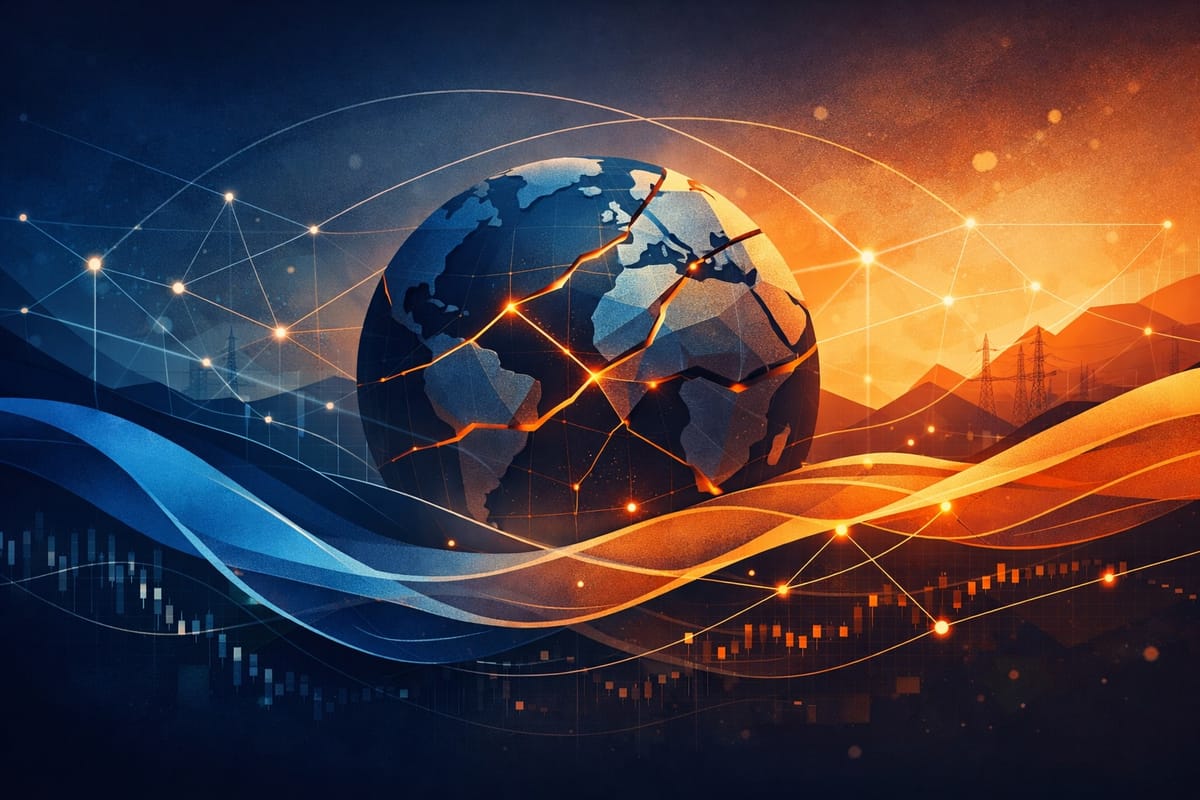
That rhythm has broken. As 2025 draws to a close, the year does not taper off so much as compress, with financial fragility, climate disruption, energy volatility, and geopolitical tension arriving at once rather than in sequence. An overwhelm when we’d prefer the slow ebbing away of noise, replaced by the calm doldrums of, well, nothing in particular. This compression, this convergence, reflects a deeper structural shift in how global operations function under strain, for as the off‑season has now somewhat eroded, instability seems to persist as an ambient condition, shaping real‑time decisions from capital allocation to trade policy and public budgets.
This is not simply “more crises”, rather, it is a change in how risk behaves over time. Systems built on the assumed alternation between shock and repair now face overlapping disruptions, shrinking the space in which institutions can reset. The result is a seasonality that feels endless: a year that never properly closes. A bit like endlessly treading water.
Markets without rhythm
On the surface, the global financial system still looks liquid and active. Equity indices sit near highs, credit continues to flow, and innovation in AI, biotech, and energy has hardly stalled. Beneath that motion, however, balance sheets are stretched and buffers are thinner than they appear after years of low interest rates, pandemic‑era spending, and repeated exogenous shocks.
The IMF’s October 2025 Global Financial Stability Report warns that elevated public debt, tighter financial conditions, and persistent uncertainty are increasing the risk that financial shocks will transmit rapidly from markets into the real economy, meaning that what once would have been localized stress in a single sector or region now appears as system-wide disruption, dispersed through highly integrated financial markets and non-bank intermediaries. The result? Central banks now have far less room to absorb those shocks without reigniting inflation or destabilizing currencies.
The United States shows the problem in its clearest form. Public debt has surged past 120 percent of GDP since the pandemic, just as higher interest rates have made that debt far more expensive to service. At the same time, budget standoffs in Washington have become routine. The result is that U.S. Treasury markets, once the most boring, reliable corner of global finance, now lurch from serene calm to violent stress, with sudden spikes in yields and moments when liquidity dries up around each new fiscal showdown.
The International Monetary Fund (IMF) and Bank for International Settlements (BIS) warn that this no longer stays contained, as jitters in treasuries ripple through global bond markets, pushing up long-term borrowing costs, and making refinancing riskier precisely when governments need that boring, reliable stability. The chain reaction kicks off: investors responding in predictable ways, clinging to cash, shortening their time horizons, and avoiding long-dated bets. It then makes sense that the big, slow projects, the power grids, infrastructure, and climate adaptation, all find themselves postponed, not because they lack value, but because they require patience and a long-term outlook in a system addicted to the inane convulsions of political theater.
The markets now move faster than policy. Computer-driven algorithmic trading now reacts to tiny bits of news at lightning speed, so a routine data release or a careless remark by a central banker can send markets jumping, only for the move to unwind days later. It’s like all our systems had triple espressos for breakfast on an empty stomach, and the problem is that the anxiety doesn’t unwind easily. Markets jerk up and down, never quite settling, and over time, investors stop treating this as a phase and start treating volatility as the normal state of being. Uncertainty becomes the default setting, and even genuinely good news is therefore met with a heavy dose of caution, pushing money toward short-term, defensive bets rather than long projects that need years of calm and rational outlook to pay off.
Energy transitions feeling the strain
Likewise, energy systems mirror the financial markets’ newfound jitters. Despite Washington’s belligerent rhetoric on wind turbines or solar, the world has continued to embrace the transition, with global investment in clean energy reaching record highs in 2024 and 2025; the IEA estimating that spending on renewables, grids, and efficiency is now more than double that on fossil fuels. And yet, under this new stress, reliability has become harder, not easier, to guarantee. The IEA’s World Energy Outlook 2025 emphasizes that while renewable capacity rapidly expands overall, the grids, storage, and transmission to handle that capacity lag behind, with spending concentrated unevenly across regions. The outcome is a system that looks greener on paper but remains vulnerable in practice, to the grand irony of increasing weather variability, supply bottlenecks, and infrastructure chokepoints.
Read: Chokepoint diplomacy: how China turned minerals into leverage
Europe exemplifies the resulting strain. After Russia’s unilateral invasion of Ukraine, governments rushed to diversify gas supplies, elevate renewables, and rebuild storage to avert winter blackouts. In headline terms, those measures largely worked: the lights stayed on, pandemonium didn’t ensue, and the worst‑case scenarios of 2022–2023 did not repeat. Yet other factors have contributed to uncertainty: recent cold spells across the continent, combined with hydropower shortfalls in southern and central regions, have both driven price spikes and forced a reliance on coal and oil backups, undoing months of emissions progress in weeks.
Power grids built for steady demand and predictable weather now have to juggle variable wind and solar, sudden demand spikes, and too little reliable backup, and when that backup is delayed or politically blocked, the energy transition loses its sense of progressive order. Instead, it shows up as grid strain, political fights, and of course, for households and small businesses, sudden price hikes and close calls with outages, rather than a smooth path forward backed up by a sense of reliance.
Shifting rainfall patterns have brought drought, cutting hydropower in parts of Asia, Latin America, and the western United States, while cold snaps have tightened the gas markets in East Asia. To plug the gaps, governments fall back on emergency fossil power and expensive LNG, driving up prices and fueling resentment over the loss of reliability and the need for viable climate policy. The contradiction is becoming hard to miss: renewables tied to weather need grids that are more flexible, not less reliable; and without faster investment in storage, grid upgrades, and demand management, energy volatility doesn’t disappear, but moves straight into the visible pain of increased household bills and subsequent political backlash.
The world without compartments
Geopolitics is changing to accommodate new stresses, and no longer comes in neat boxes. Trade, technology, security, and climate policy now collide, so a shock in one place spreads fast. We can see this in the disruptions in shipping lanes, the indiscriminate use of sanctions, or in export bans rippling through supply chains in days, not years. Trouble in the Red Sea, a cyberattack on a port, or a sudden ban on key minerals can quickly push up prices for everything from food to electronics. Perhaps a less intended effect of globalization, in the way we may viscerally experience “far away” news as it impacts our wallets.
As risks spread, everyday commerce starts to carry a political price tag: insurance gets more expensive, companies hold less inventory, and governments weaponize the tools of economic policy, using tariffs, subsidies, and controls to protect strategic interests rather than promote trade efficiency. The World Bank and OECD warn that this kind of economic fragmentation raises costs and slows growth, especially for countries that depend heavily on trade. Governments respond by trying to get a quick handle on things before they boil over, locking down at home through carbon border taxes, chip restrictions, and industrial subsidies aimed squarely at yesterday’s “friendly” supply chains. However, these moves also fracture the global system, creating overlapping rules that make coordination harder just when we need to address shared threats like climate change, pandemics, and financial shocks through strong cooperation. Supply chains may seem safer on paper, but are more fragile politically.
Domestic politics adds another layer of stress to the mix. Elections, protests, and sudden policy reversals keep governments stuck in crisis mode, while budget fights collide with climate investment; energy protests with migration and cost-of-living pressures. Leaders are left to focus on putting out fires, and not because they lack vision, but because the system no longer gives them room to plan calmly for the long term.
Related reading: Fracture, not collapse: the return of geopolitics
Enter climate, the multiplier
If anything can teach us how systems rarely operate in isolation, it’s the climate, acting as a force multiplier across systems. The WMO’s State of the Global Climate 2023confirmed 2023 as the hottest year on record, with surface temperatures, ocean heat content, sea levels, and glacier loss all hitting extremes alongside exponentially mounting losses from clustered heatwaves, floods, droughts, and storms. Whew, it’s a lot to take in.
Read this: The cost of living with risk: how climate change is rewriting the price of protection
As elsewhere, these pressures add up most quickly in the Global South. In parts of sub-Saharan Africa, South Asia, and Latin America, floods damage homes and crops, heat disrupts outdoor work, and droughts strain already tight public finances. UN and WMO assessments show how these shocks raise food prices, cut export earnings, and force governments to juggle debt payments against the pressing needs of basic services and infrastructure. This all results in less resilience, with economies recovering more slowly over time, and public trust weakening under repeated strain.
And again, this is never in isolation, so we see similar patterns visible globally. Heatwaves push power grids to their limits, floods interrupt farming and industry, and wildfires affect transport, air quality, and productivity. As the shocks come closer together, less a “once in a hundred year storm!”, as the breathless reporters may exclaim, and a regular volatility, the space to recover narrows. Planning quietly shifts away from “bouncing back” toward a sense of sheer coping and continuity; and while spending on adaptation is rising, longer-term prevention and mitigation still lag, shaped by short political cycles and benefits that are tougher to discern. Systems are left more exposed than they need to be.
Systems built for cycles, adjusting to permanence
So across finance, energy, and politics, we’re seeing the same pattern keep showing up. Systems designed for ups and downs are now operating under steady pressure, buffers wear thin, trust gets tested, and capacity is stretched. In the US, high debt limits how much governments can step in during downturns; in Europe, short-term fossil fixes linger as grids adapt; and in much of the Global South, repeated climate shocks push institutions hard, also exposing where resilience efforts matter most.
The upshot of all this is that our sense of “resilience” is being redefined. It no longer means “bounce back to normal,” but something more like “keep working even when normal keeps moving.” That’s a shift that puts a premium on governance, institutional memory, and social cohesion, all properties of a functioning, healthy society that no market model or technology can automate or give us an app for. Financial hedges can manage short-term risk, while diversified energy and supply chains can soften shocks, but neither can substitute for genuine public trust when tough choices land at home.
There is good news, though! As we move through this change, this stress, there is experience and evolution that leads to our toolkit growing. Scenario planning, stress tests, and early-warning systems are becoming more common and more sophisticated, and to make them truly effective, they need to be paired with attention to the social side: clear communication, fair burden-sharing, and credible institutions. When these elements move together, stability can become more durable and not just something that holds the ship together until the next wave smashes into the bow.
Why the year no longer closes
The end of 2025 feels unsettled on purpose. Volatility is no longer the exception; it is the background noise to life on Earth. Regional shocks now fit a global pattern rather than standing apart as rare events we can observe at a distance, and waiting for a fictional “return to normal” only postpones the harsh reality that we need a solid redesign, one that lasting change demands. Institutions that still plan for neat cycles will keep being caught off guard by the incessant waves of overlap.
Redesign under pressure is not only possible, we can see it already happening. Europe’s rapid move to diversify gas supplies after 2022, early-warning systems in cyclone-prone regions, debt-for-climate swaps, and experiments in adaptive social protection all show that systems can adjust when politics, incentives, and finance line up. The task now is to make these shifts standard practice, the new boring and reliable normal, and not emergency responses.
Stability going forward will not come from recreating a calm “off-season”, but will come from governance, infrastructure, and financial systems built on the assumption that disruption is constant, and still capable of protecting trust, dignity, and agency. That work does not start next year.
It’s almost as if the only constant actually is change!
And for us, the control will begin where the illusion ends.
Read this. Notice that. Do something.
Read this: IMF’s Global Financial Stability Report on how debt, tightening financial conditions, and automation are reshaping systemic risk.
Notice that: IEA’s World Energy Outlook 2025 - why record clean-energy investment still leaves grids exposed to weather and fuel volatility.
Do something: Before the year turns, consider how resilience begins with distinguishing what is noisy from what is structurally changing. Then, find a way to unplug for a couple of days. No screens or no politics, whatever works.
Previously on GYST: Water shock in Asia: climate, power & the cascading infrastructure crisis
Next up: Data sovereignty winter: why governments are freezing the open internet