
The return of the mega-factory: how manufacturing power is concentrating again
Global manufacturing is scaling up again. Mega-factories promise efficiency and resilience—but also concentrate power, emissions, and dependency in fewer hands. The new industrial order may prove both efficient and brittle.


For the past few decades, commercial efficiency has meant global dispersion. Since China’s entry into the World Trade Organization in 2001, globalization has promised resilience through reach: factories scattered across continents, supply chains stretched between time zones, and production allocated to wherever costs were lowest. The idea was simple: diversity would protect against disruption. Don’t keep your eggs in one basket.
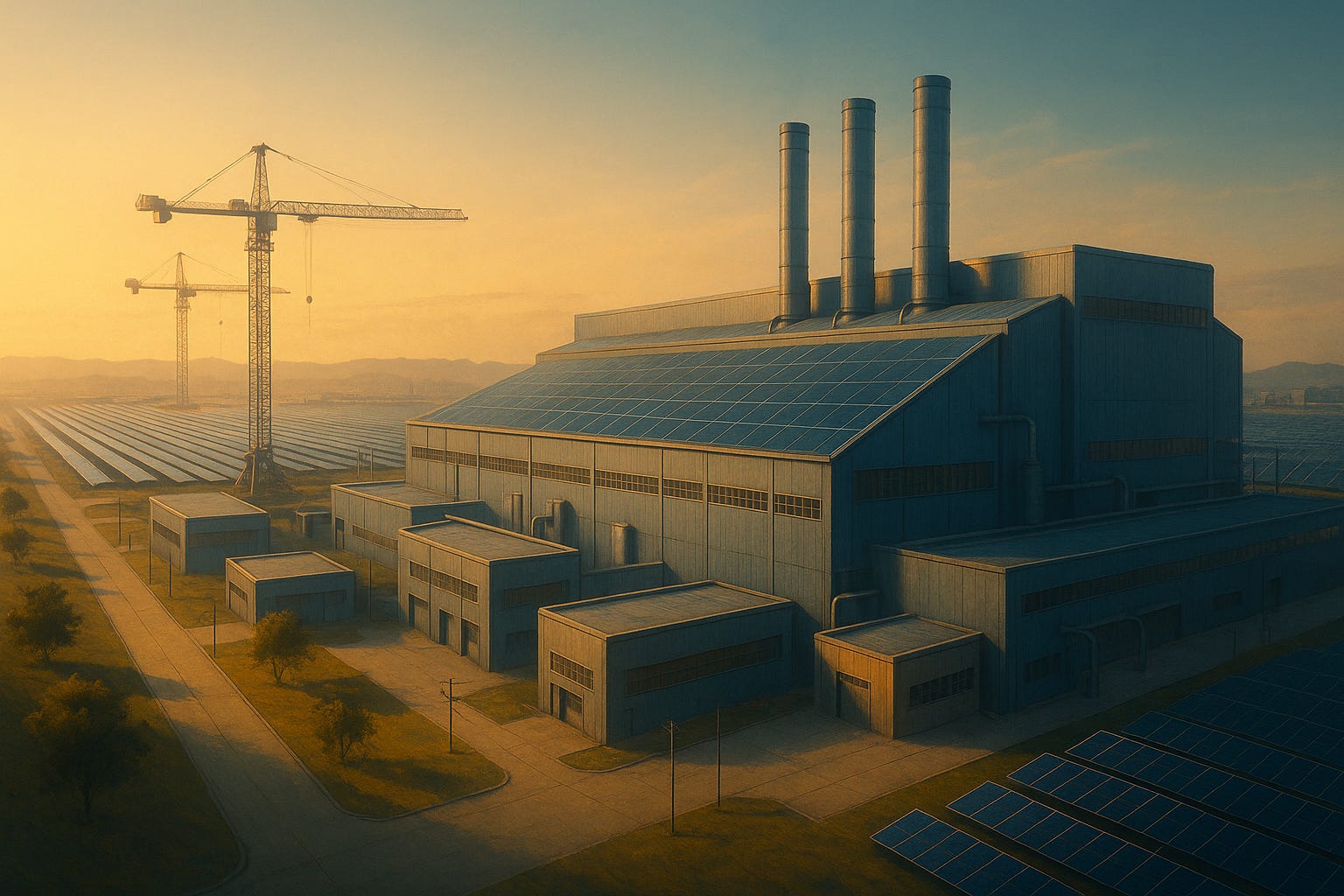
This logic had begun to erode, to some extent, long before COVID-19 or the geopolitical shocks that followed, but those crises made its weakness more visible. The global trade system, built for flexibility, proved brittle, and today, global manufacturing, once diffused among thousands of suppliers and plants, is showing signs of reconsolidation. It seems the pendulum is swinging back toward scale. Mega-factories, those vast, vertically integrated complexes powered by automation, subsidies, and cheap energy, are emerging as the new template for industrial security.
And no, this isn’t nostalgia for Fordism, for great planned cities in the Amazon, it’s a structural response to the overlapping crises we are experiencing in trade, energy, and technology. All the assumptions of the globalized era that we’ve been taking for granted, the cheap logistics, relative political stability, and predictable market demand, when these no longer hold, scale begins to look like common sense, like safety.
Read: Fracture, not collapse: the return of geopolitics
The new geography of control
A decade ago, policymakers preached resilience through diversification; now they are building it through concentration. The European Chips Act alone has catalyzed over €69 billion in combined public and private investment, backing a handful of new semiconductor fabrication sites across Germany, France, and Italy (SEMI Europe), while the OECD’s Science, Technology and Innovation Outlook 2025 describes a shift toward “ecosystems of production,” clustering R&D, manufacturing, and logistics around single integrated industrial zones (OECD).
The interesting shift is in the role that governments are playing: no longer neutral referees in global manufacturing, they are pursuing subsidy regimes, export controls, and strategic-autonomy agendas, and have turned industrial policy into an arms race. The U.S. CHIPS and Science Act and the Inflation Reduction Act have drawn hundreds of billions of dollars into battery and semiconductor plants; while Japan and South Korea are doubling down on domestic manufacturing; and China’s “Made in China 2025” blueprint has evolved into a full-spectrum industrial-sovereignty plan, a matter of building homegrown resilience and reducing external dependence. Everywhere, manufacturing is once again a matter of statecraft.
Related read: World 2.0: inside the architecture of new trade blocs
This shift, however, isn’t uniform. Certainly, we can find it most visible in high-value, capital-intensive sectors, such as in semiconductors, EV batteries, renewable-energy hardware, and grid infrastructure, where the economics of scale now outweigh the advantages of dispersion. In contrast, though, the smaller and more labor-intensive industries stand to remain global and fragmented, still governed by the imperatives of cost rather than control. So, the resulting picture is a two-speed industrial map: concentrated at the technological core, diffuse at the periphery.
Scale as insurance
The appeal of the mega-factory lies in its promise of control: by its sheer size, a single site can reduce overheads by locking in long-term energy contracts, secure direct access to raw materials, and standardize output at unprecedented scale. It’s less a “production facility” and more a “small city” in terms of the gravity it exerts, an ecosystem that brings suppliers, logistics, and workers under one perimeter. For policymakers, that self-containment offers something markets rarely guarantee: predictability. In a world defined lately by a greater sense of volatility, the ability to keep production running within sovereign borders has become its own form of insurance, so it’s no surprise that more than two-thirds of surveyed governments now prioritize “secure domestic production” in strategic sectors as a hedge against future supply-chain shocks (OECD).
And what exactly makes this greater level of overall control feasible? In one word: automation. Recent research shows that 84 percent of manufacturers plan to expand advanced automation or “smart-factory” systems by 2026 (CapGemini), and with digital twins, predictive analytics, and AI-driven process control, mega-scale plants stand to operate continuously with fewer workers, less waste, and tighter margins. Scale, once synonymous with rigidity, now enables precision.
Of course, nothing comes quite for free, and the processes at scale demand an energy logic that is equally deliberate. We’ve seen offshoring, more recently friendshoring, and now the practice described as powershoring, meaning the location of energy-intensive manufacturing near abundant renewable or nuclear capacity, in order to reduce exposure to volatile grids. Northern Sweden’s battery corridor, India’s Jamnagar green-hydrogen complex, and Texas’s renewable-industrial clusters all embody this principle, that when energy itself becomes a competitive variable, factories migrate to where power is cheapest and cleanest.
Related read: Industry 5.0: geopolitics in the age of intelligent machines
Resilience as a paradox
If dispersion—spreading production widely, if not too widely—made the globalized system fragile through its innate complexity, then concentrating it too tightly risks a commensurate level of fragility through sheer dependence. Only a handful of industrial clusters now handle most of the world’s intermediate goods requirements in electronics, automotive, and renewable energy. It goes without saying then, that when any one hub is hit, for example by cyberattack, power failure, or natural disaster, the shock ripples across sectors within days.
Related: The paradox of energy independence: why every nation still relies on others
This is the paradox of the new industrial order: the more we centralize to achieve security, the more catastrophic each failure becomes. The pandemic offered a preview: when one major semiconductor fab went offline, the resulting chip shortage rippled through entire economies. Moreover, not every region is equally equipped to sustain such scale, since concentration demands stable power, reliable infrastructure, and most critically perhaps, political continuity. Europe’s gigafactory build-out, despite generous subsidies, still lags behind China’s because of higher energy prices and slower permitting (SPGlobal); and in the Global South, industrial zones often rely on imported machinery, foreign engineers, and dollar-denominated finance. Scale without sovereignty risks becoming dependency by another name.
Capital and permanence politics
Behind the physical concentration lies a financial one. Mega-factories exist because capital has become patient, or to be more specific, is underwritten by the state. Cheap financing, green-industry credits, and loan guarantees turn initial public risk into subsequent private certainty, all to secure another headline project. In this sense, industrial policy has become a fiscal stimulus, and the risky proposition of piling all those eggs into a single basket: producing assets too big to fail and too strategic to question.
This alignment of capital and policy is also reshaping innovation itself. Venture funding now gravitates toward technologies that fit neatly inside vertically integrated systems, that’s to say manufacturing that combines top-to-bottom processing components in a single location. Think battery chemistry tied to cell plants, chip design to fabs, or green steel to surrounding renewable hubs. The ongoing quest for efficiency—fiscal, yes, but advertised in terms of energy use—has become a challenge to build a better ecosystem, the interlinked community of processes that reward those who control supply chains end to end. Plenty of innovative process development, certainly, but elsewhere, the smaller suppliers and regional firms, once the source of new ideas, are priced out before they can even start to mature.
This feels like a familiar pattern in our modern world: when policy and capital align too closely, even in the name of “efficiency”, the drive to outperform, that competitive edge in diverse economies, turns into the need to conform.
Energy, ecology, and inequality
The concentration of production also concentrates resource demand: a single gigafactory can indeed behave like a small city in the quantity of electricity it must draw from the grid. Additionally, water use, waste heat, and materials sourcing all link industrial geography directly to environmental geography, the physical processes of procuring what is required to run production. Indeed, as recent IMF research on the green-industrial transition shows, mega-clusters can either accelerate or simply undermine efforts at decarbonization, depending on how their grids and supply chains are governed (IMF).
The local effects of such concentrated activity are also harder to ignore. Industrial clustering creates jobs, and therefore all forms of demand, driving housing inflation, straining transport arteries and water systems, and deepening the sense of regional inequality. The boomtown pattern visible around Tesla’s Austin complex or CATL’s Ningde base, one of rapid, heady investment followed by social and environmental pressure, is becoming the familiar default. The politics surrounding the fervently advertised need for re-industrialization, such as have been particularly seen in the rhetoric of the current U.S. administration, thus risk reproducing the same uneven development that globalization once produced, but this time within national borders.
Sovereignty, or managed dependency?
Perhaps the broader question is whether concentration actually delivers new, tangible sovereignty, or merely reorganizes prior structures of dependency? A resilient economy requires not just factories and physical buildout, but the institutional capacity to regulate them, the energy to power them, and the political will to govern them transparently and as long-term, embedded investments. It’s a similar proposition to the mathematical headaches of proposing, say, a nuclear power plant, based on X number of decades’ lifetime use. So, the more manufacturing power converges in mega-sites, and when it does so at least successfully in the short-term outlook, the greater the leverage of those who own, finance, or supply them.
Industrial planners face a dilemma well known in finance: concentration delivers efficiency and exposure in equal measure. For example, a single data center failure can cripple communications networks; or one chip-plant shutdown can spook global trade. What looks like resilience for a business can still be fragile for the greater system. The task, therefore, is to build counterweights to this risk, namely redundancy, modular capacity (ironically), transparent standards, and shared responsibility for oversight, all before the next crisis exposes the gaps.
Finally, there is also a democratic cost, since once production is framed as an essential component of national security, the scrutiny narrows. The mega-factory becomes a symbol of sovereignty and progress, a potentially lumbering institution that is too strategic to fail, too costly to question. It comes down, once again, to the prevailing short-termism mentality of national politics, for if projects at mega scale can provide governments with visible proof of action for their voter base, then in the midst of those triumphs, the closer ties entangling them to the interests of their corporate allies are less visible.
The decade ahead
The reconsolidation of manufacturing is not a return to the past but an adaptation to the new landscape of general global economic volatility, of the shifts and changes that comes with the fracturing, then drift toward multipolarity. It promises a measure of control in a world of disorder, for sure, yet it also shifts risk upward from the local to the systemic, and thus the potential for greater damage should things go wrong. The industrial geography of the 2030s, therefore, will likely be defined by a set of hybrid realities: clusters of hyper-efficient production surrounded by vast networks of dependency.
History suggests the momentum will always, eventually favor expansion. The demand for infrastructure, energy transition, and digital hardware leaves little room for deliberate, top-down policies of restraint. Austerity in any form tends to be an ill-advised and politically damaging policy in the short term. The real test is whether concentration can ultimately deliver security without reviving the fragilities it was meant to end, whether it will be seen as a progressive step toward future global resilience.
Read this. Notice that. Do something.
Read this: SEMI Chips Act Report 2025 on how industrial policy is re-engineering Europe’s manufacturing geography.
Notice that: OECD’s Economic Security in a Changing World analyzing how states are consolidating supply chains to hedge against systemic shocks.
Do something: Use a tool like ArcGIS Knowledge to check industrial footprints. It lets you plot production sites, suppliers, transport links and overlay energy, logistics or geopolitical data.
Previously on GYST: Manufacturing water: the politics of an engineered resource
Next up: The death of the open internet: what replaces the world’s last shared space