
The paradox of energy independence: why every nation still relies on others
Energy independence is the ultimate paradox: every move toward self-sufficiency, from national policy to rooftop solar, creates new dependencies. The only real autonomy is transparency and accountability in shared systems.

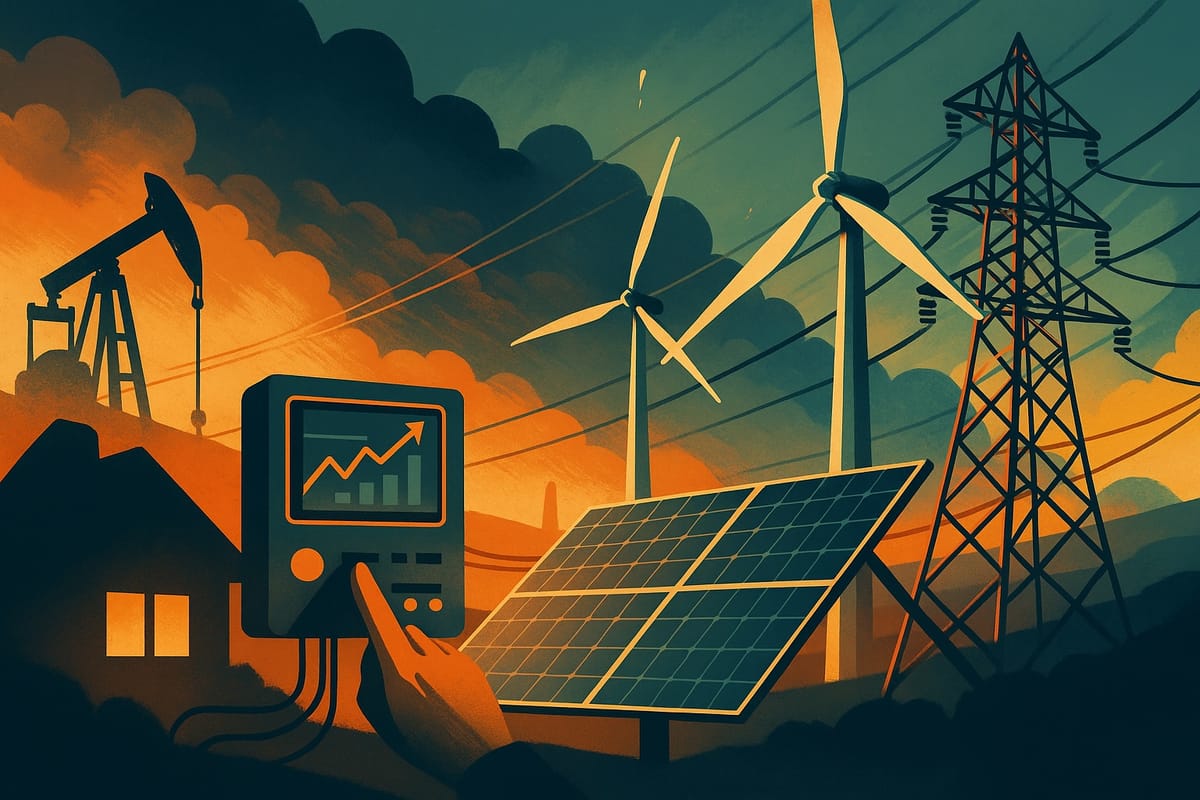
“Energy independence” has always been a seductive phrase. It promises a distinct sense of control, the idea that if a country, company, or household can generate its own power, it can stand apart from the world and its turbulence. Politicians deploy it as shorthand for sovereignty, while investors sell it as a hedge against volatility. Yet the closer we come to actually realizing it, the more elusive it becomes.
From macro to micro, national grids to rooftop panels, attempts to close the energy loop only reveal new kinds of exposure: to minerals, software, weather, and global markets. The twenty-first century’s paradox is that the more we are able to decentralize our energy systems, the more tightly they knit the planet together.
The myth of self-sufficiency
The modern notion of energy independence was born in the oil shocks of the 1970s, a reaction to vulnerability and the desire to escape the geopolitics of supply and direct constriction of demand by energy powers. However, half a century later, no economy has actually achieved it. Even the United States, now the world’s largest combined producer of oil and gas, still imports crude oil, components, and capital. Europe’s drive for energy autonomy after Russia’s invasion of Ukraine has merely reshuffled its suppliers. Liquefied natural gas (LNG) terminals sprouted on the North Sea, certainly, but the molecules intended for processing arrived from Qatar, the U.S., and Nigeria.
So, the dependency map simply changed shape, not nature. The pieces were shuffled around the board. Solar and wind were supposed to break that logic, yet their lifecycles are still based on geoeconomic reliance, tracing back to Chinese polysilicon and Congolese cobalt. According to the International Energy Agency’s Critical Minerals Market Review 2024, demand for the minerals behind clean-energy technologies has risen by more than seventy percent since 2017, and supply chains are now more concentrated than those even for fossil fuels. The notion of independence, in material terms, is a statistical fiction.
The grid that binds
Renewables introduce a subtler dependency, that of intermittency. Both sun and wind tend not to obey borders, so balancing them effectively demands interconnection, flows across time zones and jurisdictions. The European Network of Transmission System Operators (ENTSO-E) now coordinates more than forty cross-border electricity links, and every new solar farm in Spain or wind park in Denmark strengthens the case for deeper integration, not separation. Even in the current political climate, the U.S. Department of Energy has reached the same conclusion: regional interconnections are the cheapest path to grid stability, yet zoom out and they require the very federal coordination that the “energy independence” rhetoric resists.
Storage is the other side of the energy coin to generation, and it introduces its own web of interconnected necessity. Batteries rely on lithium from Chile or Australia, nickel from Indonesia, and graphite from China, efforts to onshore production quickly meet environmental and permitting limits. The World Bank’s Minerals for Climate Action report projects mineral demand for the clean energy transition could triple by 2050, and this will simply repeat history, shifting the leverage from OPEC to a “new OPEC”, a cartel of mining states. The supply chains may be greener, but they are no less political.
The household mirage
The idea of decentralization brings the illusion home. Rooftop solar, home batteries, and electric vehicles promise personal autonomy, for certain, a liberating micro-independence from the grid. In practice, they shift reliance from the utilities to the manufacturers, financiers, and software providers. To underline this, think of a solar-plus-battery system, which is a web of contracts: panels from China, inverters from Germany, apps from California, and financing from a domestic bank. Each sits inside another dependency loop, a matryoshka of layered reliance.
Smart meters and demand-response programs connect households to algorithms that decide when devices run or pause, so, in a sense, energy sovereignty becomes conditional on cloud connectivity and cybersecurity. A local blackout can be fixed by an electrician; a ransomware hit on a grid operator can darken entire regions. Consumers gain a sense of control because they can monitor flows on a screen, but real power lies in firmware updates, data ownership, and the terms of service. This is why we must take a step beyond consumer tech, as real energy freedom at home must begin with digital rights, not just hardware on the roof.
The promise of agency
And yet, the pursuit of independence endures for a reason. Beneath the myths and marketing lies something real: the search for actual, personal agency in an increasingly digital world in which we feel control wrested from us. At every scale, the personal, commercial, and national, the search for autonomy is driven by a democratic impulse, even when its full execution remains out of reach, partial. A household that installs solar panels isn’t simply chasing savings; it is asserting a degree of control over an abstract, often unaccountable system. This act matters, of course, even if the panels were manufactured abroad and financed locally. The point is to transform energy, something we use constantly yet have no fundamental consumer relationship with, from a distant commodity into a tangible civic choice.
For companies, that same logic translates slightly differently, into innovation. Industrial users that build microgrids or invest in on-site storage gain resilience against price shocks and blackouts, certainly, but they also open the door to experimenting with new governance models: shared generation, local trading, efficiency by design (instead of the blind acceptance of built-in obsolescence). Their independence does not isolate them, rather, it places them within a network that rewards transparency and cooperation. The result is not self-sufficiency, per se, but smarter dependency, where visibility and reciprocity replace the traditional context of hierarchy.
And at the level of the state, independence becomes something altogether more grand, an expression of sovereignty, the ability to choose one’s dependencies rather than have them imposed. Nations that diversify supply, build flexible grids, and engage in fair exchange are not rejecting globalization, but are finding a space in which to reshape it on more equitable terms. True autonomy, as we can see, is the capacity to decide when and how to connect.
Ultimately, this is the constructive, real-world face of energy independence: not escaping from the constrictions of the system, but active, reward-based participation in its redesign. The transition toward distributed generation can, and emphatically should, be a democratic project, one that turns citizens, firms, and governments from passive consumers into active stewards of power.
New dependencies, new politics
For governments, however, the language hasn’t quite caught up. The idea of “energy independence” still polls well, so leaders promise it to capture voting share even as they are busy designing systems of interdependence. The examples are many: the United Kingdom’s North Sea revival, India’s Atmanirbhar Bharat (“self-reliant India”), and the United States’ Inflation Reduction Act all blend the audible rhetoric of autonomy with a reliance on global supply chains.
Voters hear sovereignty; planners see logistics.
And yet, the decentralization of power generation also has a civic consequence: it moves both electrical and political power closer to citizens, and that results in a collaborative impulse. Municipalities and cooperatives now own solar fields; farmers host wind farms; households trade surplus power through peer-to-peer networks. The democratic question is shifting from who controls supply to who coordinates the system. In parts of Germany and Denmark, for instance, community energy schemes already seat local cooperatives at the same tables as the grid operators, so we can see a new form of participatory infrastructure that necessarily depends on transparency rather than isolation.
The geography of risk
There is, of course, another component of the energy transition equation that complicates matters: climate volatility as a result of anthropogenic global heating. Hydropower facilities may fail in drought-stricken regions and heatwaves make thermal plants temporarily redundant, illustrating how national independence plans may be dashed when deteriorating or unpredictable global weather intervenes. The 2023 Rhine low-water crisis cut German coal shipments and raised electricity prices across Europe; while cyclones in Southeast Asia wiped out solar installations built for “resilience.”
In a sense, where renewables are concerned, the atmosphere itself is the grid, so if follows that true autonomy is a mirage of scale. Regional compacts such as ASEAN’s Power Grid and the African Union’s Continental Power System Master Plan frame integration as an issue of security, not dependence, and the same principle drives undersea cables like the Morocco–U.K. link and hydrogen corridors through the Mediterranean: the pursuit of stability through connectivity.
The contention, therefore, is that every successful project of the next decade will depend less on walls and more on shared standards, open data, and mutual audit. Somehow, this feels like we’ve come full circle.
From autarky to accountability
True resilience, whether at the national, commercial, or individual level lies in accountability. Citizens rarely see the externalities hidden behind the marketed illusion of autonomy: lithium brines draining Indigenous lands, solar-panel waste, and predatory offshore labor conditions. It stands, therefore, that to make those links visible, we must turn that dependency from liability into civic responsibility.
If independence once meant detachment, the libertarian notion of escape from the system, then its modern meaning is participation: being able to see, question, and shape the systems that deliver power. In democracies, at least, that means smooth, effective public oversight of contracts, environmental standards, and data ownership; while in authoritarian systems, the opacity of supply chains becomes yet another instrument of control that may seem to deliver quicker benefits, but which may be founded on less regulated systems.
The contest ahead is between an open web of interdependence and a closed patchwork of captive markets. Energy freedom now depends less on generating alone and more on taking the responsibility to govern together. And that means openly, accountably, and in full view of those it serves.
Read this. Notice that. Do something.
Read this: Energy autonomy, at present, is a comforting fiction. For deeper context, see the International Energy Agency’s Critical Minerals Market Review 2024, the World Bank’s Minerals for Climate Action report, and the ENTSO-E overview of European power interconnections.
Notice that: Every path to independence, whether national, corporate, or personal, creates new dependencies in minerals, software, and weather.
Do something: Support open data on supply chains and grid governance. Energy freedom is not cutting ties, it’s knowing who you’re tied to.
Previously on GYST: Law or leverage: South Korea’s moment of truth at Gyeongju
Next up: AI and the capacity to govern: can democracy keep up?