
MENA’s water reckoning
Water, not oil, is becoming MENA’s defining resource challenge. Scarcity, desalination, and hard trade-offs are reshaping politics, economics, and daily life across Western Asia and North Africa.

Editor’s note on naming: Most headlines still say “Middle East”, a colonial shorthand centered on Europe. At GYST we use MENA, ‘Western Asia and North Africa’, more accurate, less eurocentric. You may still see “Middle East” when we quote sources, but our baseline is MENA.
From oil narrative to water reality
For a long time, the region’s story was hydrocarbons. While that lens still matters, the more immediate pressure is the arithmetic of water. MENA is the most water-strained region in the world, with roughly 83 percent of its population living under extremely high water stress. That is the baseline from World Resources Institute’s Aqueduct analysis, and it is the starting point for everything that follows (WRI).
Scarcity is not new, climate is not the only driver, and governance quality can often be the difference between a hard year and a crisis. As demand rises with urban growth and agriculture, as aquifers are overdrawn, and as temperatures push evaporation higher, the map of power is being redrawn not just by pipelines, but by rivers and aquifers.
The new map of scarcity
Stress is unevenly distributed, but the overall pattern is quite clear. Gulf economies rely on seawater desalination to meet municipal demand; Levant states stretch thin supplies across growing cities; Iraq and Iran face upstream–downstream tensions and persistent groundwater decline; and across Arab states, the United Nations Economics and Social Commission for West Asia (ESCWA) warns that many countries remain off-track on integrated water management, with institutional gaps a core risk to supply and social stability (ESCWA).
However, what looks like a technical problem is, in practice, a political one. Rationing schedules, leakage rates, agricultural allocations, and tariffs are political choices, and they can, therefore, carry tough political consequences. A poor hydrological year can easily turn into a test of political legitimacy if enforcement is weak or concession deals too ‘opaque’.
Desalination at scale, and the energy–water trade
There is no modern MENA water story without desalination. Gulf states produce a large share of the world’s desalinated water, upwards of 31% according to the Pulitzer Center, and due to technological advances and pro-desal policies, capacity keeps rising. However, while desalination solves part of the problem, it is energy-intensive, generates huge quantities of brine, and can lock systems into costly loops if power remains fossil-based. The strategic shift now under way is clear, to couple desalination with renewables and efficiency so that every additional cubic meter does not come with an outsized energy bill.
This is where climate policy meets utility engineering. The faster systems reduce leakage, reuse treated wastewater, price heavy consumption fairly, and power desalination from clean energy sources, the less brittle the water economy becomes.
Transboundary rivers and downstream politics
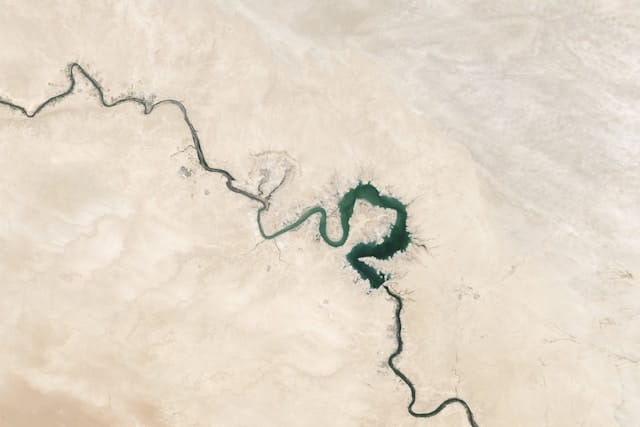
Scarcity is also aggravated by geography. For example, upstream storage on the Tigris–Euphrates has long been contentious, and the downstream reality is visible in Iraq’s marshes and farmlands, where the physical realities of salinity and drought collide with the human frailty of governance gaps. Recent reporting captured one of the worst droughts in a century in southern Iraq, a reminder that stress cascades through fisheries, agriculture, and migration, and that recovery is not simply a matter of looking ahead with unfounded hope to the succor of the next rainy season (Al Jazeera).
To the west, the Jordan Basin’s chronic scarcity has pushed governments toward new arrangements that link infrastructure, finance, and diplomacy, meaning that, in practice at least, regional politics now move alongside pipes and power lines.
Jordan’s pivot as a regional case study
Jordan is one of the driest countries on Earth. Over recent years it has tightened loss-reduction programs, invested in network upgrades, and pursued a national project to decouple municipal supply from volatile flows. The Aqaba–Amman Water Desalination and Conveyance Project, backed by European and multilateral finance, is designed to deliver large volumes from the Red Sea to the highlands, with parallel efficiency work to reduce losses in the system (European Investment Bank).
It is important to stress, however, that this is not a silver bullet. It is a hedge. It acknowledges that conservation and reuse help, but that new, reliable sources are desperately needed to actually stabilize what is a rationed system. It also signals a policy sequence for other water-stressed states to follow: reduce losses, reform tariffs carefully, secure diversified supply, and build political support around reliability, rather than short-term relief. It is ultimately a reminder that, critically where the issues of anthropogenic climate change are examined, it is longer-term, intergenerational policymaking that is most sorely needed.
Agriculture, cities, and the politics of allocation
Any serious plan must confront agriculture’s share of withdrawals. In many MENA countries, farms account for the majority of water use, yet produce a modest share of GDP. Cutting allocations is politically hard, and switching crops for less water-intensive options or improving on-farm efficiency both take time and money. But the math remains constant, unwavering. Without shifts in cropping patterns, better irrigation, and expanded reuse of treated wastewater, cities and farms will remain locked in a zero-sum fight, and groundwater decline will continue inexorably.
This is also where equity enters the story. Poor neighborhoods feel rationing first, while smallholders feel the economics hardest, in terms of price shocks. Real, considered, long-term reform spreads efficiency gains and protects basic needs, instead of socializing scarcity and privatizing reliability out of the hands of those who need it most. And any reform needs to be inclusive, to include and respect the input of all actors in the process, as a recent (and excellent) report by the Center For Strategic & International Studies (CSIS), Surviving Scarcity, points out:
Governments should view civil society as an ally in this process, rather than a threat. Activists, scientists, and academics can identify polluters and raise awareness among local communities on the need for change.
(CSIS, 2024)
Why this matters beyond the region
Water scarcity is altering risk in MENA, and with it trade, investment, and diplomacy. You can see it in utility balance sheets as energy costs rise with desalination. You can see it in migration patterns from parched rural districts to coastal cities. You can see it in new bilateral frameworks where water supply, power swaps, and financing are negotiated together. This is not a niche environmental issue, it is a central driver of political economy, likely the central driver, along with multiple parallel ‘climate’ or ‘environmental’ considerations, from here on out.
A useful frame from the World Bank is to treat water scarcity as an institutional challenge as much as a hydrological one, since credibility, pricing, and enforcement determine outcomes as much as rainfall does. That is why the reform agenda, and not just the climate trend line, will shape who adapts and who faces cycles of crisis (World Bank).
For readers tracking the redistribution of choice in world politics, watch how water reorders priorities faster than ideology does. Reliability, not rhetoric, is what builds consent in systems under stress.
Read this. Notice that. Do something.
Read this: WRI Aqueduct on where stress is already extreme (WRI), ESCWA on governance gaps and progress across Arab states (ESCWA Report 10), and Al Jazeera’s ground reporting from southern Iraq’s drought belt (Al Jazeera).
Notice that: The states moving fastest pair supply projects with efficiency and reuse, and tie desalination to cleaner power to control long-run costs. Watch Jordan’s carrier project and how Gulf utilities align water builds with grid and solar.
Do something: Calibrate your feeds. For every national headline about scarcity, read one institutional source and one regional outlet. Track three policy levers in each case, not just rainfall: loss reduction, wastewater reuse, and tariff reform. These determine whether scarcity becomes a crisis or a manageable constraint.
Previously on GYST: Latin America’s lithium triangle and the resource gamble
Next up: India’s strategic hedging after Tianjin, and what “poly-alignment” looks like when water, energy, and security are negotiated together.