
Manufacturing water: the politics of an engineered resource
Around the world, water is shifting from geography to engineering. Desalination offers relief from drought — but at the price of energy, equity, and environmental strain. The new politics of water are already washing ashore.

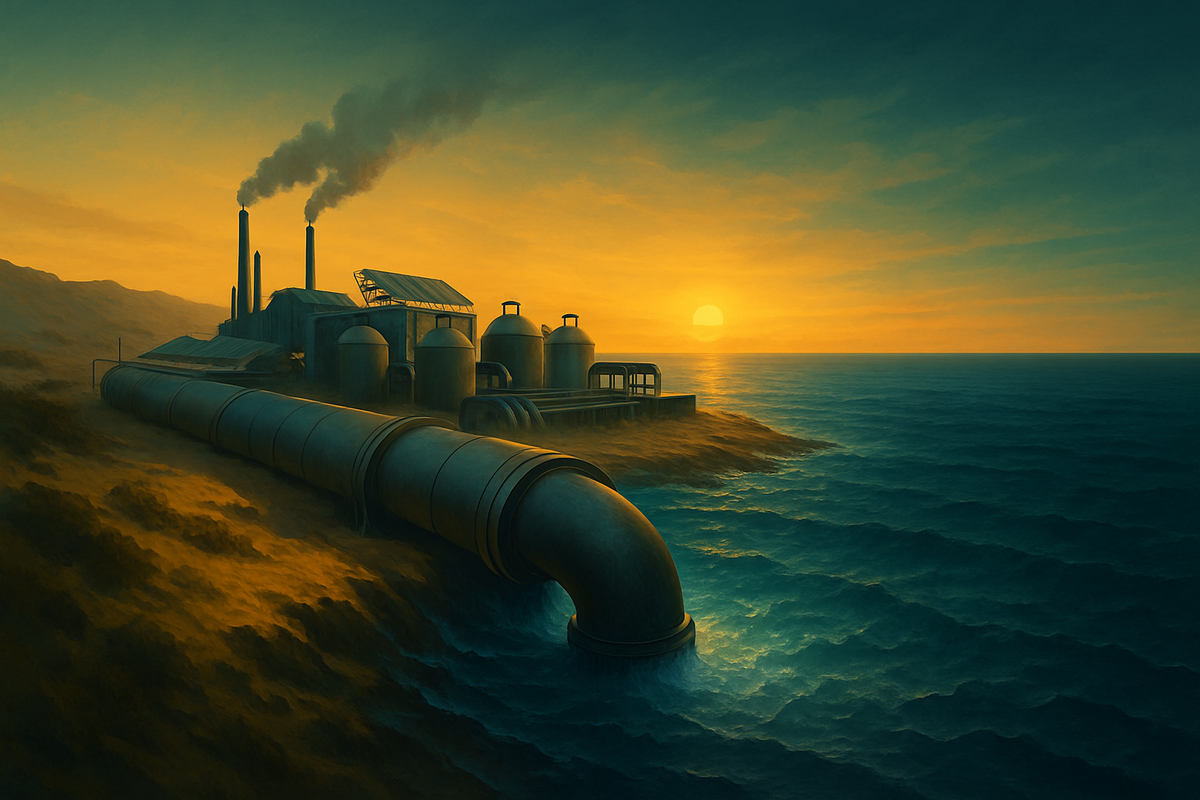
The promise of limitless water comes tethered to limitless energy demand — and to the politics of who pays that bill.
For centuries, water scarcity has been, mainly, an obvious problem of geography. Cities grew where rivers ran, agriculture followed the rains, and governments planned around the cycles of wet and dry. The story of water, its availability, has been the story of our species. However, that logic is now starting to collapse: over the past decade, droughts, population growth, and industrial expansion have converged to make freshwater supply one of the most fragile foundations of the global economy.
As rivers shrink and aquifers collapse, governments are turning to the one reservoir that never runs dry: the sea. Seawater desalination, once a futuristic experiment, is becoming a default, necessary solution, but its spread is also exerting big changes, unassumedly rewriting the political economy of water. It’s a self-evident first step to look to our oceans to fix the problem, but while the solution offers stability, it also hard-wires dependency, energy demand, and environmental cost into the very systems meant to save us from drought.
A market of necessity
The numbers tell the story. Industry forecasts now value the global desalination market at more than US $40 billion by 2033, up from roughly US $17 billion last year, as countries rush to build new plants and upgrade old ones (GlobeNewswire). This equates to more than 21,000 facilities now operating worldwide, and whereas a decade ago, most were clustered around the Gulf, today they circle the Mediterranean, the coasts of China, the Americas, and the Indian Ocean. The momentum toward desalination adoption is strongest in middle-income economies that have outgrown their natural hydrology but still depend on water-intensive industries: energy, mining, agriculture, and heavy manufacturing (TrendResearch).
Morocco is emblematic of this new era. After six straight years of drought, the government has decided to go all in, turning desalination into national policy. It was recently reported that Rabat plans to produce 1.7 billion m³ of desalinated water each year by 2030, powered partly by wind and solar capacity along the Atlantic coast. The flagship Agadir plant—already one of Africa’s largest—is being expanded from 275,000 to 400,000 m³ per day, with a €250 million upgrade designed to supply both municipal taps and nearby farms (Reuters). Elsewhere across North Africa, similar projects are accelerating: Algeria is refurbishing aging Gulf-era plants; while Egypt and Tunisia are courting private investors to fund new ones.
Further east, the pattern continues. In the Gulf, desalination has long been lifeline infrastructure, but even so, the twin pressures of population growth and industrial diversification are pushing demand to new records. The United Arab Emirates now draws more than 90 percent of its domestic water from the sea, and Saudi Arabia is building hybrid solar-powered plants to cut the energy cost of its vast system. In East Asia, China’s northern provinces, where the double whammy of groundwater depletion and industrial growth collide to create critical shortages, there is significant scaling up of coastal desalination to feed factories and cities, with studies projecting China’s desalination capacity to more than double within a decade, rising from US $1.8 billion to US $4.6 billion in value (GlobeNewswire).
Get GYST in your inbox and support this Substack, free.
The high cost of clear water
While the seas promise a vast new source of supply, they are far from a free resource, and every cubic meter of freshwater drawn from salt water must pay the price of physics. Desalination is a triumph of pressure and precision: seawater is forced through ultra-fine membranes until only water molecules remain. The method, known as reverse osmosis, works, but at a cost. Each cubic meter demands roughly three to four kilowatt-hours of electricity, making desalination one of the most energy-intensive technologies on any grid.
Furthermore, since most nations still rely on fossil fuels for grid power, every sip of desalinated water carries an inherent carbon cost. And as global energy demand for desalination has already doubled since 2010 and could double again by 2030, the technology could rival the projected electricity use of the world’s data-center industry (World Economic Forum). Water security, in other words, is now inseparable from energy security: if the grid fails, so does the water supply.
This dependency hasn’t gone unnoticed, and some nations are testing cleaner designs. Saudi Arabia’s NEOM Green Hydrogen Project links electrolysis, solar power, and desalination in a closed-loop system intended to produce both hydrogen and potable water with minimal emissions. While often cited as a flagship project, the context merits caution. NEOM’s sister megaproject, The Line, was promoted as a utopian desert city, the somewhat bizarre 170 kilometers of mirrored towers housing nine million people. The project recently collapsed under cost, complexity, and a heavy dose of reality. After more than US $50 billion invested, construction is now largely suspended and ambitions quietly abandoned (Middle East Eye). NEOM, on the other hand, is at 80% construction completion, but The Line shows how quickly grand promises can become stranded assets. If NEOM succeeds, it could define a new water-energy model; if it fails, it will stand as proof that ambition without realism is just spectacle.
Even where desalination is more routine, oversight still often remains brittle. In Israel, a government inquiry found that major plants repeatedly exceeded permitted salinity limits while falsifying water-quality data to appear compliant. Over eighteen months, chloride levels at the Sorek A plant reached four times the legal threshold, while Palmachim engaged in similar manipulation. Regulators imposed reforms and demanded free water as compensation, but the episode exposed how even advanced systems are still vulnerable to the age-old frailties of human avarice: cost-cutting and regulatory capture (Times of Israel). The issue was not technological failure but governance, and we see the slow erosion of accountability once water becomes an industrial product.
California offers a different caution. The US $1.4 billion Poseidon Water project at Huntington Beach was canceled in 2022 after the California Coastal Commission unanimously denied its permit, citing excessive cost, marine risk, coastal-flood exposure, and a lack of clear demand for its water (CalMatters). Together, these cases show that the same technology can look like salvation or self-inflicted strain depending on how it is powered, managed, and justified.
The cost of clarity
By now this may sound like further bad news, but we need to be clear here: the price of desalination doesn’t end with how the process is powered, with electricity. Every liter of freshwater pulled from the sea is, as we have seen, filtered, and this leaves behind an equal or greater volume of brine. This is dense, hot, laced with treatment chemicals, and has to go somewhere. But where?
Most plants are currently rather basic in design, built for quick results as opposed to circular, longer-term considerations. Unsurprisingly, they discharge the brine back into the ocean, creating invisible plumes that reshape local chemistry. Across the Persian Gulf, the Mediterranean, and the Red Sea, environmental monitors have documented spikes in salinity and temperature that generally do nothing great: stressing coral, seagrass, and fisheries already weakened by warming and pollution. Bottom line: this is very likely to “severely degrade” coastal ecosystems, according to a 2024 review (Smart Water Magazine).
As with many things recently, the technologies to reduce this impact do exist, such as in mineral recovery or controlled mixing, but each adds layers of energy use and capital expense, something that doesn’t quite fit with the short-termist business model of getting a plant up and running to start filtering seawater yesterday. In the race to draw clean water from the sea, we risk leaving the sea itself dirtier and the process ever more expensive to sustain.
This is not an abstract cost, either. Desalinated water is rarely cheap, and its price determines who benefits. The embedded capital expense of building plants, pipelines, and grid connections pushes tariffs to three times higher than conventional supply. So, while wealthy cities and industries can absorb such costs; poorer communities cannot, and without subsidies or cross-pricing, desalination risks effectively propagating inequality, creating literal islands of abundance amid scarcity.
In Chile’s Atacama Desert, for example, multinational mining companies pump desalinated seawater hundreds of kilometers inland to keep copper and lithium operations alive, while nearby rural towns still ration drinking water (The Guardian); and in Mexico’s Baja California Sur, household tariffs for desalinated water rose 40 percent last year after energy-price spikes made electricity imports costlier (IWA Publishing).
These examples are all cited to point out how, what begins as a technological fix for scarcity, a reaction to an obvious, immediate problem, can end as a feedback loop of growing cost and exclusion. Energy, ecology, and equity are now bound together in a cycle where the water that saves us is affordable only to those who least need saving.
Who owns the trap
Behind the physical build-out lies a new financial and governance architecture, one that makes clear how resources such as clean water mirror the politics of exclusion. The Gulf monarchies rely on sovereign-wealth funds and state utilities; North Africa favors public-private partnerships; and Latin America’s projects are increasingly financed by mining consortia and multilateral lenders. The World Bank and the European Investment Bank, meanwhile, have both introduced blended-finance models for water infrastructure, allowing private firms to recover capital while governments guarantee long-term offtake.
Sure, such structures do accelerate construction, but they also privatize control and shift accountability. Financing water therefore means governing it. Analyses of water-sector corruption show that public-private-partnership models and high-complexity infrastructure projects are especially vulnerable to rent-seeking, opaque procurement, and weak oversight. (Transparency International).
So, we’re really just rehashing an age-old resource story: whoever holds the concession, holds the tap.
Pipeline power
To expand on that sentiment, we could add that whoever holds the tap, shapes the politics that flow from it. This is a governance gap that now intersects with regional security: in the Horn of Africa, for example, Saudi and Emirati investment in coastal desalination plants doubles as soft power, a mechanism to provide drought relief while securing political alignment. In South Asia, India’s expanding desalination network along its southeastern coast is increasingly entangled with broader competition over changing Himalayan water flows. Climate diplomacy is extending offshore, and the nations who are able to finance and export desalination capacity are offering it as aid or leverage to those that cannot.
We can keep extending the inference here. When water becomes industrial, it becomes a commodity for transaction. While we may like to think transactions are just, fair interactions, they are rarely neutral.
Governments are trying to manage these trade-offs. Morocco and Saudi Arabia link desalination directly to renewable-energy build-outs to offset emissions and stabilize their long-term costs. Spain and Israel are experimenting with wastewater reuse and advanced brine treatment to soften ecological impacts. In Spain’s dry southeast, especially around the Segura Basin, treated wastewater is no longer seen as waste, but is part of the regular water supply. The country now treats and reuses much of its urban water, turning what once went down the drain into a dependable source for farming and daily use. This reuse system is built into national policy and closely regulated, giving Spain a reliable alternative to draining aquifers or running costly desalination plants. The challenge, as always, is balance: to keep the water clean, affordable, and available without pushing the energy bill or environmental impact too high.
Despite these efforts, however, global oversight remains thin. Most plants operate under national or municipal permits, with patchy enforcement and opaque or limited data. International guidelines under the UN Environment Programme’s Regional Seas conventions exist, but compliance is voluntary and monitoring uneven. (UNEP).
The danger is, of course, that desalination will echo the pattern of past infrastructure revolutions, and we will continue to do what we seem to do best: build fast, justify with necessity, and regulate only after the damage appears, which, it will be noted, is an increasing, compounding damage scenario that requires endless attention.
Water from the sea feels limitless, yet its production reshapes coastlines, power grids, and political economies. It also diverts attention from cheaper, less spectacular fixes, the unglamorous work of conservation, leakage reduction, crop-switching, and equitable allocation of resources in the first place. The allure is stunningly obvious: for politicians, desalination offers a visible solution of steel, turbines, ribbon-cuttings, all shiny progress you can photograph into political success. The quieter work of changing consumption habits is far less cinematic, and so it waits in the wings for, it hopes, a non-speaking role, maybe.
Designing abundance
Still, and despite the costs, outlandish energy requirements, and worryingly bad precedents, the technology does work, so it will keep spreading. It has to. In the face of accelerating climate volatility, the political imperative for guaranteed water outweighs most caveats. The question, therefore, is not whether desalination expands, but how its inevitable expansion is governed. If treated as critical infrastructure, something we integrate into energy planning, environmental protection, and social policy, then it can help stabilize fragile regions. If treated as a quick fix, it risks deepening the very weaknesses it’s meant to repair.
The deeper shift may be conceptual. For millennia, our societies organized themselves around where water existed; now, we are learning how to manufacture it. In this sense, the desalination boom marks a fundamental transition from the natural constraints of geography to the perceived limits of engineering. Our ability to manage scarcity in this way is indeed a triumph of technology, yet packaged with a warning:
Every new cubic meter of water pulled from the sea reminds us that abundance, like scarcity, now depends on design.
Read this. Notice that. Do something.
Read this: “The world’s water race is accelerating — but at what cost?” Reuters on Morocco’s Agadir desalination expansion and how renewable-powered plants are redefining water policy across North Africa.
Notice that: Transparency International’s Topic Guide on Corruption in the Water and Sanitation Sector details how PPPs and large-scale water infrastructure create governance and accountability risks.
Do something: Explore UNEP’s Regional Seas Programme to see how regional frameworks for marine-pollution control — including desalination discharge — rely on voluntary cooperation and uneven enforcement.
Previously on GYST: COP30: Staying the course or stalling out?
Next up: The return of the mega-factory: why manufacturing power is concentrating again