
Law or leverage: South Korea’s moment of truth at Gyeongju
As APEC opens in Gyeongju, South Korea faces a test on two fronts: defending its trade treaty against U.S. pressure and showing that democracy can still hold its own in a world of power politics.

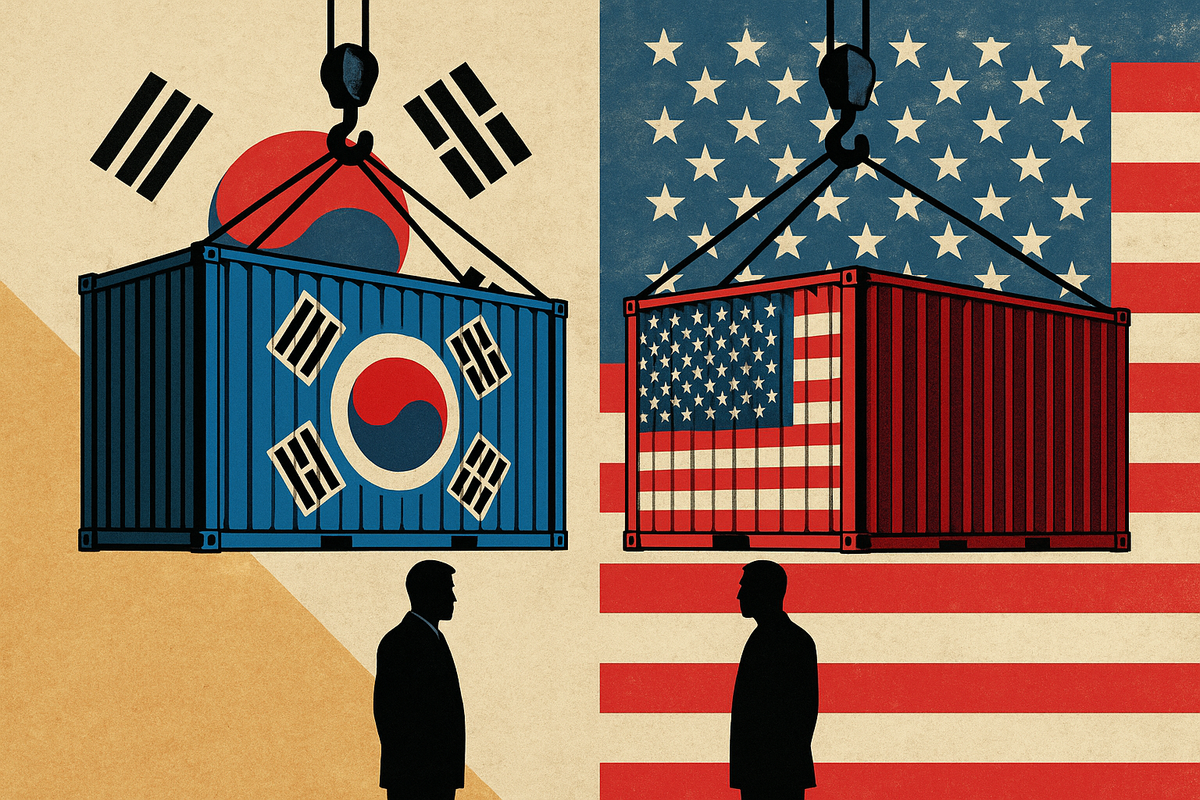
When Asia–Pacific leaders gather in Gyeongju this week, South Korea will play host to a summit layered with symbolism. Asia-Pacific Economic Cooperation (APEC) 2025 is billed as a meeting on trade and growth, yet the quieter, more decisive test concerns the rules that underwrite both, the relations between nominal allies. The United States and South Korea, bound by the 2012 free-trade agreement known as KORUS, arrive at an awkward moment.
Washington’s new tariffs on Korean goods, paired with a demand for massive investment pledges, have thrown that treaty into question. For Seoul, the issue is no longer technical or merely trade, it is whether legal order still restrains power when even allies start bending the terms they wrote.
A treaty under strain
The United States–Korea Free Trade Agreement eliminated tariffs on about ninety-five percent of traded goods and bound both countries to equal treatment and transparent arbitration. Its strength lay in predictability, providing stability: each side knew that the vagaries of domestic politics would never outweigh treaty law. That assumption no longer holds.
However, that principle cracked this year when Washington imposed sudden, sweeping new tariffs on Korean exports and then, in a September meeting, demanded roughly US $350 billion in American investment as the price of relief. Seoul rejected the ‘proposal’, calling it economically impossible and legally indefensible. (Reuters).
Under KORUS, a country can temporarily protect a specific product line from trade attack, but not whole industries, and tying tariff relief to new investments breaks both the treaty’s fairness rules and its purpose. What Washington calls negotiation looks, to most experts, like pressure disguised as policy. Or, to be less charitable and more realistic, coercion.
Seoul’s delicate line
Naturally, President Yoon’s administration is trying to navigate that coercion without blowing up the alliance. Korea’s economy and security both rely on the United States, yet accepting what is a de facto ransom would both invite political revolt at home, and signal to other partners that rules are perhaps not concrete, and are negotiable. A slower, staged investment plan has been floated, one with joint ventures and guarantees rather than a single lump transfer, a move to keep talks inside the treaty’s legal framework.
The USTR’s own KORUS summary stresses consultation before retaliation, and Seoul’s measured tone shows it is opting to discuss the matter first, still intending to use the channels Washington created, yet no longer respects. Analysts argue that each new tariff demand erodes the trust underpinning U.S. alliances, warning that Washington cannot pretend to champion a rules-based order while treating its partners as exceptions to it. (Carnegie).
Japan’s new tilt
Meanwhile, Japan’s brand new prime minister, Sanae Takaichi, has promised to prioritize the importance of closer coordination with Washington on technology controls and maritime defence. In short, a major focus on the retention of close working ties with the U.S. Her arrival, having just been sworn in during the past week, pulls Japan out of a politically delicate moment and, having reemerged with focused rhetoric, strengthens the trilateral bloc. However, in doing so it also compresses Seoul’s diplomatic room to maneuver.
Top of the international agenda lately are the trade concerns around the tech sector, and Korea must cooperate on semiconductors and supply chains while also asserting its independent legal obligations. If the communiqué in Gyeongju elevates “trusted supply chains” above references to KORUS, it would confirm that hierarchy, projected through coercion, has replaced law as the organising principle of working relations.
Beijing, the SCO, and the optics of ‘fairness’
Despite projections of regional leadership and global economic influence of late, China will enter the summit looking for tariff relief of its own, coupled with a chance to rebrand itself as a predictable, trustworthy partner. So, if Washington grants China concessions while keeping pressure on Korea, the optics will be severe: reward the autocracy and punish the democratic ally.
That dynamic contrasts sharply with the recent Shanghai Cooperation Organisation (SCO) summit, where Beijing and Moscow courted developing economies under the banner of “non-interference.” The SCO gathering offered an alternative vision, one of hierarchy, but with consistent rules conferred through power rather than through law. Gyeongju is, perhaps, its mirror image: a democratic attempt to restore credibility through treaties rather than transactions. The two summits together show how the global system is fracturing, not between East and West, but between forms of governance: on the one hand by agreement; on the other by demand.
For Seoul, standing by its treaty at Gyeongju is defense of its sovereignty, certainly, but also a rebuttal to the power-based approach seen at the SCO.
The question of money
Trade, however, isn’t the only fault line here. Washington has been pressuring Seoul to increase payments for U.S. troop basing even though those costs were supposedly already fixed by a five-year Special Measures Agreement, a budget instrument subject to parliamentary oversight, and in no way a discretionary fund. Again, by openly circumventing legally agreed precedent, in tying these ‘contributions’ to a sense of goodwill and favored standing, the U.S. is effectively ignoring the value of international alliances. Unexpected as this was, no bribery statute applies, but the practice echoes the logic of protectionism, of racketeering: security as a service, renewed by payment.
For South Korea, falling in line with U.S. pressure here would convert what is still a treaty partnership into a ledger of debts, effectively caving in to bullying. If it resists those pressures, it forces it to expose the contradiction between America’s legal rhetoric and its actual political methods. Outing the bully, so to speak.
Domestic dissent
Inside Korea, that contradiction has spilled into the streets. Demonstrations openly against the U.S. president have grown across Seoul since the tariff announcement, and these have united labor unions, students, and civic groups, all under slogans defending the need to preserve national dignity and democratic sovereignty. Protesters see the investment demand not as policy, but as direct tribute, and they accuse Washington of treating Korea as a vassal rather than as a trusted, long-term ally.
Treading a narrowing political line, the government’s response has been cautious, acknowledging “public concern” while urging calm. The images, however, matter, and tens of thousands gathered outside the U.S. Embassy is a reminder that alliance politics, no matter how international in nature, are also fundamentally domestic politics. Yoon’s approval ratings have dipped as opposition parties have been quick to accuse him of subservience, while his defence minister has warned that pushing back too forcefully could jeopardize military coordination.
Between these opposing poles, the administration is trying to show that both firmness and diplomacy can coexist, but whether voters accept that distinction is something that will shape Korea’s internal balance, the swell of national pride versus the pragmatism of restraint.
Law, leverage, and democratic credibility
The deeper question is what this standoff says about the state of democracy itself. In a sense, how the political strains now visible within the United States are seeping outward, shaping how its allies experience and interpret the very principles that once defined the partnership. Treaties like KORUS exist to insulate cooperation from the politics of personality and pressure. When they are rewritten mid-term or openly used as leverage, they lose their moral force and their utility. And for mid-sized democracies like South Korea, that loss can be existential: if written agreements no longer protect them, then finding leverage, power, becomes the only language left to use.
Seoul’s quiet assertion within legal bounds may look cautious, but it is the essence of democratic governance. It insists that legitimacy flows from process, not persuasion. And in a global political environment increasingly defined by executive fiat, the imposition of personal gain and public spectacle as a diversion from power plays, Seoul’s insistence is becoming both rare and radical.
For readers beyond Asia, this isn’t distant and disconnected diplomacy. If Washington’s commitments become negotiable, every partner that depends on U.S. trade guarantees, from Europe to Latin America, faces the same uncertainty.
What Gyeongju will reveal
The clues, the subtle diplomatic direction, will hide in the communiqués. If the leaders mention “tariff review mechanisms under existing frameworks,” legality has survived. If they praise “voluntary investment partnerships,” then law has given way to convenience and political pressure. For South Korea, success will not be counted in tariff percentages, but in whether KORUS itself remains intact.
Seen against the SCO’s consolidation and the protests at home, Gyeongju becomes more than a venue. It is where a democracy tests its ability to defend its principles on two fronts: against foreign power and against domestic cynicism.
Read this. Notice that. Do something.
Read this: Reuters’ summit preview outlines how Seoul is positioning itself ahead of Gyeongju, pursuing tariff relief while refusing to surrender its legal footing under the U.S.–Korea trade deal.
Notice that: The U.S. Trade Representative’s KORUS summary sets out the consultation and non-discrimination principles Washington helped write, while the Carnegie Endowment for International Peace warns that each time those standards are breached, it chips away at alliance credibility and the legitimacy of rules-based order.
Do something: Read the Gyeongju communiqué closely. The language, whether it cites “existing treaty mechanisms” or “voluntary partnerships”, will show whether democracies still trade by law or by leverage.
Previously on GYST: World 2.0: inside the architecture of new trade blocs
Next up: The paradox of energy independence: why every nation still relies on others