Ethiopia’s big dam gamble (and China’s Global South play)
Ethiopia’s Grand Renaissance Dam is more than a mega-project. It’s a test of sovereignty, a flashpoint for Nile politics, and a showcase of China’s growing role in the Global South.

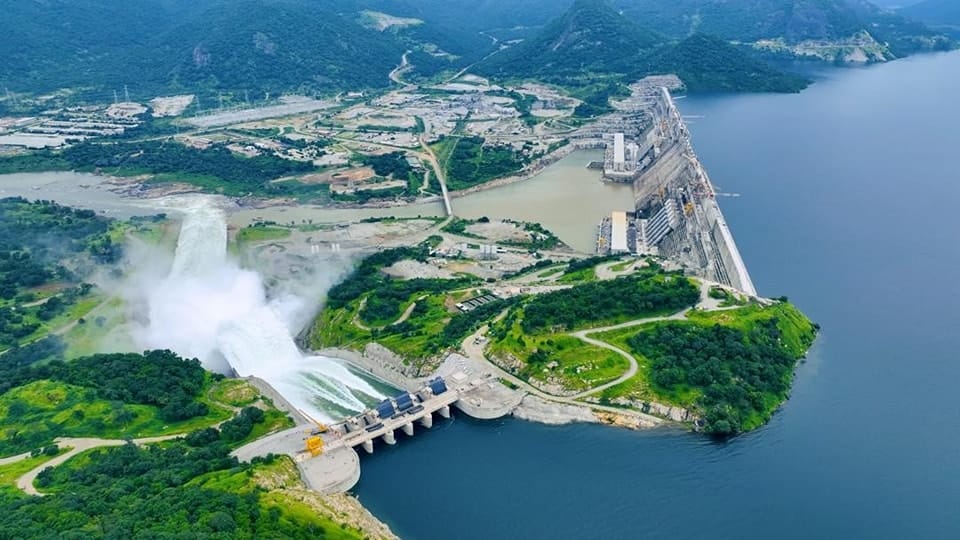
The Grand Ethiopian Renaissance Dam is more than a power project, it’s a statement of sovereignty, a climate battleground, and a grand stage for China’s influence in Africa.
At the end of August 2025, Ethiopia formally inaugurated the Grand Ethiopian Renaissance Dam (GERD), a hydroelectric project on the Blue Nile (to confirm, the Blue is the larger and the White the smaller of the tributaries that eventually form the Nile) that has been years in the making. Now with 13 turbines finally online, the dam’s installed capacity now sits between 4,875 and 5,150 megawatts, less than the 6,450 MW originally planned, but still utterly transformative for Ethiopia’s grid, doubling the nation’s power supply and positioning the country as a regional energy exporter (Al Jazeera).
To put that in perspective: even at reduced output, GERD could supply the equivalent of 15–17 terawatt-hours annually, and that’s enough electricity to power 10–12 million households depending on consumption levels.
For Addis Ababa, the GERD is more than just (admittedly huge) infrastructure, it is a statement of national sovereignty, a project financed in large part domestically and widely celebrated as the keystone of Ethiopia’s future growth. However, it is also a geopolitical flashpoint, one that unsettles neighbors downstream and offers an opening for external power interests, chief among which is China, whose financing, technology, and diplomatic support have made the GERD not just an Ethiopian project, but a case study in Beijing’s growing role in the resource politics of the Global South.
Power, sovereignty, and the Nile question
The Nile is not just a river; it is the lifeline of several nations. Egypt depends on it for more than 90 percent of its freshwater, while Sudan’s own hydropower and irrigation infrastructure rely heavily on its flows. For both nations, the GERD represents an upstream lever with potentially existential consequences.
Since construction began in 2011, Cairo has warned of water insecurity and loss of control. The dispute has seen years of fraught trilateral negotiations between Ethiopia, Egypt, and Sudan, often brokered by the African Union or the United States, but rarely yielding any durable compromise. A Chatham House report noted that the core issue is not just water volume, but timing: Ethiopia wants to maximize power generation, while Egypt fears that if GERD reservoirs are filled too quickly, drought years could ensue that will devastate its agriculture.
The dam’s recent inauguration, in any case, underlines Addis Ababa’s refusal to bow to outside pressure. Ethiopia argues that GERD is about electrification and dignity, not the denial of Nile flows downstream. And in a country where half the population has lacked reliable access to power, that claim of dignity resonates domestically. Sovereignty, though, must come at a cost: for every new kilowatt Ethiopia generates, the political temperature in Cairo rises.
Enter China
Present at every stage of the GERD story, Chinese firms have supplied turbines, transmission lines, and financing packages that complemented Ethiopia’s own fundraising drives. Beijing’s role, it must be noted, however, is more than technical. By backing Ethiopia’s sovereign development model, China has positioned itself as an alternative to Western lenders and, more critically, as a partner for nations that want infrastructure without strings attached.
The GERD dovetails with the Belt and Road Initiative (BRI) across Africa, linking dam power to industrial sites, rail networks, and telecom infrastructure all built with Chinese support. In this sense, the project is as much about shaping the regional political economy as it is about simply pushing electrons through the grid. A Brookings analysis argued that Beijing’s alignment with Ethiopia is emblematic of the working model going forward: China offers infrastructure that enhances state capacity, even if it risks, in this case, literal downstream friction.
This is where the Global South angle comes into crystal focus. The GERD is not a Chinese dam, but it is a Chinese story: a showcase of how Beijing pursues leverage by enabling the realization of significant projects in emerging economies that are on the one hand highly contentious, but utterly transformative on the other.
Regional ripples
Put simply, the GERD will alter the politics of energy and water in northeast Africa. Through the new dimension of national generation capacity, Ethiopia intends to position itself as a regional hub and export power to Djibouti, Kenya, and Sudan. The risk, however, is clear: selling electricity to neighbors will not erase the disputes surrounding who controls the river itself. Harnessing the river’s power may only exacerbate those disagreements.
The politics have been complex, to say the least. Sudan has walked a fine line, sometimes siding with Ethiopia to secure access to cheap power, yet sometimes with Egypt to ensure water stability. Cairo, meanwhile, has faced away and courted the Gulf states, seeking the solidarity of Arab League backing and even exploring desalination megaprojects as insurance (Daily News Egypt). The Nile has thus become a regional test case both for climate resilience and power politics, all rolled into one, and demonstrating how resource access ultimately sits at the base of climate- or politics-related concerns.
Zooming out from immediate neighborhood relations, if Ethiopia succeeds in stabilizing domestic electricity supply while also exporting surpluses, the GERD could become a model for African resource sovereignty: a national project leveraged into regional, continental influence. If not, it risks being remembered as a contentious flashpoint that deepened rivalries, made Egypt retreat into a sense of vulnerability, and gave China an even firmer diplomatic foothold (read: geoeconomic control) in Africa.
Climate stakes
While long marketed as clean energy, climate change complicates the calculus for hydropower. Predictive modeling suggests the Nile basin will see greater rainfall variability in coming decades, on a river system where predictability, stability, have secured life’s right to flourish for thousands of years. Too much rain could overwhelm reservoir management, whereas too little could exacerbate scarcity. Even the scale of megaprojects now exerts an effect: GERD’s very size makes it more vulnerable to climate swings, a fact that could turn what was meant to generate stability into a project that supplies volatility.
As we learn ever more, everything in our world is connected, and this, therefore, matters beyond Ethiopia. As the International Energy Agency notes, hydropower remains the backbone of renewable generation in much of the developing world, and GERD’s success or failure will shape our perception of whether mega-dams are still a viable approach in what will continue to be a warming century.
Dam as diplomacy
The GERD is not just about water, electricity, or even Ethiopia: it is a case study in how the politics of climate, sovereignty, and global competition intersect. The dam epitomizes the redistribution of choice: who gets to control flows, who finances transitions, and whose definition of ‘development’ ultimately prevails.
For the Global South, the GERD may offer a symbolic rallying point: a project built to harness local resources but against the wishes of stronger downstream neighbors, backed by China, and justified via the language of dignity and energy access. For the West, it is a reminder that infrastructure and resource diplomacy, as we see the effects of anthropogenic climate change in action, is now geopolitics by other means.
Read this. Notice that. Do something.
Read this: Reuters on the GERD inauguration; Chatham House on Nile negotiations; Brookings on China’s role in African hydropower.
Notice that: downstream politics remain unresolved, each year of drought risks reopening the Nile question, and every new power export line increases Ethiopia’s geopolitical ties to China.
Do something: whenever you see “infrastructure diplomacy,” track who builds, who provides the finance, and who controls the operations. The GERD is one dam, but similar resource-power dynamics are unfolding from Latin America’s lithium fields to water battles in Southeast Asia.
Previously on GYST: MENA’s water reckoning; Latin America’s lithium gamble.
Next up: China’s next five-year plan, and how AI factors in.