
Copper wars: Latin America’s race to wire the green transition
Copper is the quiet force behind the energy transition. From Chile to Peru, the metal that wires the future is now reshaping global power itself.


As the world scrambles for the metal that powers electrification, Latin America’s copper belt finds itself caught between Chinese investment, Western re-industrialization, and the limits of its own re
Copper was the workhorse of the last century, the ‘new old metal’, hidden in walls, grids, and engines. Now it is the critical metal of electrification: electric vehicles use far more copper than combustion models, and grid upgrades, wind turbines, and data centers depend on it even more. Prices currently sit near two-year highs, and the International Energy Agency (IEA) warns that demand growth and concentrated refining capacity could further tighten markets as the decade wears on (IEA).
Latin America, specifically in the area from northern Chile’s Atacama to Peru’s highlands, supplies a large share of mined copper, and as a result has been courted by Beijing and Washington. One offers downstream industrial integration and long-term offtake; the other, “friend-shored” supply chains and financing opportunities. What used to seem like a regular commodity market now reads as a very strategic game of chess.
Chile: the giant under strain
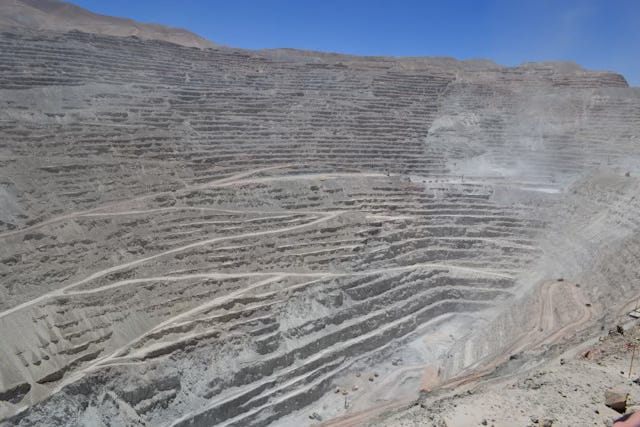
Of the major supplier nations, Chile still sets the pace, but its crown is slipping. Codelco, the state miner long praised as a public-sector success, has struggled to lift production from a 25-year low, this being the product of aging deposits, delayed modernization policies, water constraints, and stoppages due to safety issues. Company guidance has repeatedly emphasized a sense of confidence in gradual recovery; nonetheless, output remains under pressure and investors are watching closely in terms of how this plays out in risk (Reuters).
In Santiago, copper remains the fiscal lifeblood of the markets, but the regulatory targets for decarbonization have raised the bar for water- and energy-intensive projects. Desalination and renewable power are now integral to “green copper,” yet they require significant time and additional capital to shift from “business as usual”. The policy line “state-led, private-partnered” is both coherent on paper and hard in practice: expansion must happen, of course, but without repeating the environmental shortcuts of the last boom, and enduring the associated costs that would accompany a repeat of history.
Peru: promise and paralysis
Peru also faces a sense of duality: it has the ore… and the volatility. Yes, it is a top global exporter, but output is vulnerable to recurrent protests and a definite political churn. Chinese investment anchors major operations, yet community blockades and revenue-sharing disputes have repeatedly knocked significant tonnage offline. The United States, via the Minerals Security Partnership, is courting Lima with alternative financing; and so Beijing counters with integrated processing and offtake. Overall, projects move, but often slower than the energy transition demands.
Panama and the politics of extraction
As the third notable supply player, Panama has the distinction of supplying the cautionary tale. In late 2023, First Quantum’s Cobre Panamá mine was shut down by the government following mass protests and a court ruling against the mine’s contract, a significant move since this is the mine that had contributed about one percent of global supply and roughly five percent of Panama’s GDP. The closure triggered a slew of multibillion-dollar arbitration claims, then tentative moves toward negotiation in 2025. As of mid-year, authorities approved a maintenance/safety plan, stressing it was a continuation and definitely not a restart (Reuters).
The lesson for the region is double-edged and something we keep coming back to at GYST. Assertive “resource nationalism 2.0” plays well domestically and can correct lopsided contracts, fine. However, abrupt reversals have knock-on consequences, raising financing costs and pushing investors toward jurisdictions more willing to trade speed for standards. When the commodity in question is a transition linchpin, short-term thinking rules, and a local permit dispute can ripple through global climate plans.
Where the real control sits
Today, leverage lies less in ore, the base of the value chain, than in processing, the value add. China refines the largest share of the world’s copper and, as such, dominates the downstream manufacture of the essential products that use copper: cathodes, wires, and other components. No surprise, therefore, that western capitals are racing to secure more mines, since Beijing already controls the necessary conversion steps that turn bare rock into industrial power. The IEA notes that refining is far more concentrated than mining, with China on track to control nearly half of global refining value by 2030. (IEA).
We have seen this emergent structure before, in the case of the nickel and lithium sectors, where export policies, Chinese capital, and midstream capacity determine who is actually capturing value.
The West plays catch-up
Washington and Brussels are awake to the imbalance, and in recent years (and under different leadership) have sought to shore up the divide. The U.S. Inflation Reduction Act (IRA) and Europe’s Critical Raw Materials Act both put copper on strategic lists, but the incentives lag behind the on-the-ground realities of permitting and the concentration of midstream economics. The U.S. initiated its Minerals Security Partnership to co-finance projects in Chile and Peru, yet it cannot suddenly expect to replicate a decade of state-guided investment in smelting and wire plants. Western investors also face tighter ESG constraints and litigation risk, something that should promote more stable long-term growth. However, while this can be an asset and cleaner copper should command a premium under emerging carbon-border rules, this is only feasible if policy aligns with project timelines.
Contradiction reframed as strategy
Copper’s climate paradox is straightforward: the very metal that enables decarbonization is itself carbon-intensive to mine and refine. The answer is not fatalism; it is process evolution through better design. Both Chile and Peru have world-class solar resources, and electrified mines powered by renewables, seawater desalination, and lower-carbon smelting can produce “green copper” capable of competing on embedded emissions, not just on cost. If we pair that with ESG-based implementation of transparent revenue-sharing practices and comprehensive, actioned environmental baselines, then the ‘issue’ of climate becomes leverage rather than liability.
This is climate as strategy, the realization of what underpins ESG. At its simplest, it means challenging the current way of doing and seeing the pragmatic business outcomes of enacting change through technology, system re-evaluation, and information transparency. Rather than moralizing about footprints, governments can trade lower-carbon copper for technology, financing, or market access. Europe’s carbon-border regime will push exporters to disclose and reduce process emissions, meaning those who move first can set the reference price for “clean metal.” The alternative is to watch premiums accrue elsewhere while domestic debates stall at the unassailable binary wall of yes or no.
The wiring of the new order
Copper is the connective tissue of the twenty-first-century economy, wiring our grids and vehicles, but also the sovereignty of states that either master the midstream economics for themselves, or accept dependency on those who do. For Latin America, the stakes are concrete and visibly threefold:
- Market volatility that rewards short-term output spikes over long-term capability.
- Geopolitical rivalry that can turn mines into proxy assets for the agendas of other, greater powers.
- Domestic legitimacy that demands environmental and social credibility as the price of extraction.
If these three pieces of the puzzle are competently handled, copper revenue can fund a cleaner, more resilient industrial base. If not, the energy transition’s wiring will be built elsewhere, with the region again exporting rocks while importing value from elsewhere, a continuation of the economic colonialism of the last century.
As of now (October 2025), the race is no longer hypothetical. Mines are slowing or surging on the back of local politics; refineries are locking in offtake years out; and demand for megawatts of wire, not barrels of oil, is becoming the quiet measure of power. The question for Chile, Peru, Panama, and their neighbors is whether they will merely sell the ore of the future, or help shape how the future is built.
Read this, Notice that. Do something.
Read this: IEA, Global Critical Minerals Outlook 2024 on demand, refining concentration, and copper’s role; Reuters on Codelco’s struggle to lift output off a 25-year low, how execution risk meets tightened markets, and also Reuters once more on Panama’s Cobre Panamá shutdown and its economic toll, how legitimacy can reshape the contours of supply overnight.
Notice that: Concentration in refining, not just mining, is both where strategic dependence forms and where China’s advantage is stickiest. Chile and Peru both have domestic politics that can move global prices; while Panama showed how fast legitimacy can close a mine.
Do something: Treat climate as strategy. If you’re a policymaker or investor, back projects that pair copper output with renewables, desalination, and transparent revenue-sharing, the bundle that earns a premium under carbon-border rules and reduces midstream dependence.
Previously on GYST: The Silent Harvest: China’s Soybean Split
Next up: The vanishing pact: inside the collapse of the Tigris–Euphrates order