
Climate before blocs: Pacific states chart their own course
At the Pacific Islands Forum, leaders sidelined both Washington and Beijing to focus on climate and cooperation. The Pacific shows how even small states can resist bloc politics — and why that matters in a fractured world.

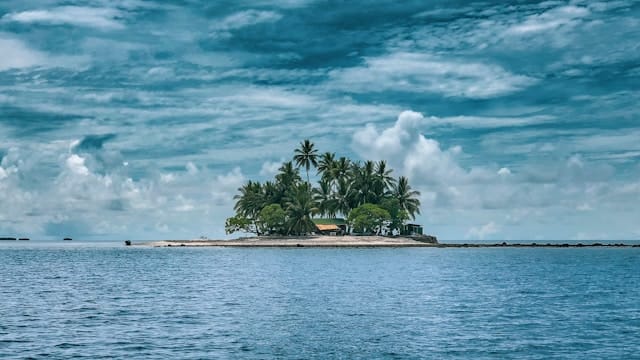
Small island nations are pushing back against the U.S.–China rivalry by setting their own terms. Their leverage may be modest, but their choices matter.
For decades, the Pacific islands have been treated as a strategic backdrop. Airstrips, naval bases, and postcard coastlines on the way to somewhere else. Somewhere languid, unmoving, quiet. This month’s Pacific Islands Forum (PIF) gathering in the Solomon Islands, however, underlined something different: the small states of the Pacific are determined to no longer be chess pieces in a new Cold War. In a telling move, leaders kept both the United States and China rather firmly at arm’s length, refusing to let their rivalry, or any single side of it, dominate the agenda (RNZ).
This quiet resistance matters. It suggests that the global order isn’t simply splitting into two oppositional blocs, as during the Cold War, but this time led by Washington and Beijing. Instead, in between, small and vulnerable states are carving out space, asserting that they too get to set terms. For an era defined by “fracturing, not collapse,” the Pacific offers a frontline example.
A long memory of external power play
To understand the present, it helps to recall how Pacific states experienced the last round of ‘great-power politics’. The islands, to a great extent simply due to their geographic qualities, were Cold War outposts. The United States used the Marshall Islands as a nuclear testing ground; France continued nuclear tests in Polynesia until into the 1990s; and Britain and Australia ran joint facilities. Local populations bore the unsolicited costs: radiation, displacement, and lingering health problems.
That legacy explains a deep, understandable skepticism toward foreign promises, and many island governments see today’s scramble for bases, fiber-optic cables, and port projects through the lens of past, recent past, exploitation. When Washington talks up “Indo-Pacific security,” or when Beijing offers loans for infrastructure, leaders remember how earlier great-power projects ended: when the outsiders took off and left the locals to clean up the mess.
This historical memory fuels the determination to avoid being conscripted into geopolitical service again.
Why the Pacific matters now
The Pacific Islands are home to just 13 million people across more than a dozen countries, strewn across a seemingly infinite ocean larger than all the world’s land combined. While their economies are small and their militaries negligible, their scattered, expansive geography means they control vast exclusive economic zones, rich fisheries, and potential new, or as yet undiscovered seabed resources. All this, and they sit astride the vital maritime routes linking the economies of Asia and the Americas (Lowy Institute).
For outside powers, the Pacific is a prize, if not the prize, and nations, just as in the 1800s, seek to gain a toehold. The U.S. still holds legacy bases in Guam and the Marshall Islands; China has expanded aid, loans, and security agreements, most controversially with the Solomon Islands; Australia and New Zealand, meanwhile, the traditional regional anchors, are now competing with new entrants such as India, Japan, and even the UAE. Everyone wants a flag planted somewhere in Oceania.
And yet, at the PIF meeting in Honiara, island leaders deliberately excluded both Washington and Beijing from headline roles. Instead, they focused on the pertinent issues pressing their own economies: climate, ocean governance, and intra-Pacific cooperation. The symbolism was unmistakable: we are not here to rubber-stamp outside rivalries.
Climate first, always
For Pacific governments, the existential issue is not the balance of naval power but the rapidly increasing effects of anthropogenic climate change. Rising seas threaten entire nations, while ever more intense cyclones batter what were already fragile economies. The region’s leaders have long argued that climate is a security issue, and they are using every diplomatic lever to push it onto the global agenda (Al Jazeera).
What needs to be stressed here is that this pressure is more than just rhetoric. In 2023, Vanuatu secured a landmark UN resolution asking the International Court of Justice to issue an advisory opinion on states’ legal obligations to tackle climate change (UN). The case is proceeding, and it reflects the Pacific’s strategy: to leverage moral authority in the face of visible, documented damage due to climate change, so it may amplify its voice globally.
By defining climate as the real security threat, Pacific leaders are able to reframe the texture of external engagement. Therefore, aid or investment that doesn’t directly acknowledge and support adaptation, renewable energy, or fisheries management buys little political goodwill. The message is consistent: help us survive, or don’t expect loyalty in your great-power contest.
The politics of aid and debt
The Pacific is one of the most aid-dependent regions in the world. While Australia is still the largest donor, China’s arrival has tangibly changed the equation, and its lending surge in the 2010s left several countries, including Tonga, with debt worries (Lowy Aid Map). The U.S. continues to underwrite governance and services in the Compact of Free Association states, while Japan and the EU provide targeted development and climate finance.
In this emergent environment of big power interest in the Pacific, Island governments are naturally adept at playing donors off against one another. Fiji, for example, ‘recalibrated’ relations with Beijing and Canberra in recent years to maximize assistance, while the Solomon Islands leveraged Chinese security deals to extract more attention from Washington. Even tiny Nauru has flipped diplomatic recognition between Taiwan and the PRC, severing relations with Taipei last year in exchange for Beijing’s financial support.
This balancing act doesn’t come without risk, however. Heavy reliance on external funds is no substitute for fundamental domestic economic development, and it can leave states vulnerable to sudden pressure, from delayed payments to cyberattacks. Yet it does also prove that small states don’t have to be totally passive, but can maneuver actively within the fractured landscape.
Agency in practice
So how does that maneuvering translate into active geopolitical moves? Well, examples abound of Pacific states asserting agency: Palau maintains recognition of Taiwan despite Beijing’s offers, prioritizing its own political values; Kiribati switched recognition to China in 2019, then used Beijing’s support to upgrade infrastructure; while in 2021, Micronesian states threatened to quit the PIF over leadership disputes, forcing a reform that kept them engaged.
Each of these cases illustrates the same point: small states have leverage when they act collectively or when they treat recognition, access, or votes as bargaining chips. In a fragmented order, those chips have gained value and are being played.
Fracturing at the micro scale
If we zoom out, the Pacific’s maneuvering fits the larger pattern the economist Neil Shearing describes as the fractured age: globalization continues, but political loyalties reshape its flows (FT). Small states are not just caught in the cracks, they are actively reshaping them from within.
The Pacific shows that “fracturing” is not only a story of the U.S.–China rivalry or European energy shifts, it also plays out in the decisions of climate-vulnerable nations that refuse to be slotted neatly into blocs. Their leverage may be limited, but collectively, they can either slow down or redirect the trajectory of great-power designs.
Why this matters beyond the Pacific
For larger audiences, the Pacific story can look a little parochial. However, it really does matter, if only for these three reasons:
- Climate diplomacy: If the Pacific keeps climate as the top agenda item, it strengthens global pressure on major emitters elsewhere.
- Small-state precedent: From the Caribbean to East Africa, other smaller nations can emulate the model of saying no to binary alignments.
- Blocs with caveats: The Pacific reminds us that bloc-building is never a neat and tidy exercise. Even the smallest states have veto points they can use to larger effect.
In a fractured global order, veto power matters. When votes at the UN General Assembly are counted, when climate finance mechanisms are negotiated, or when undersea cable routes are laid, the preferences of small states can tip outcomes. The discernment of a shift away from globalization as we have known it does not mean lowered overall trading volumes, despite tariff plays from an aberrant U.S. administration.
The Pacific will still be sitting squarely in the middle of the dominant geopolitical power shifts in the coming decades, and with the spotlight on the destructive effects of climate change, Pacific states will stand to grab even more attention globally, allowing them to continue charting their own existential course.
Read this. Notice that. Do something.
Read this: Al Jazeera coverage of how Pacific leaders sidelined both Washington and Beijing at the PIF. And take a look at this great Lowy Institute infographic map to note the distribution of aid.
Notice that: UN reporting on Vanuatu’s ICJ climate initiative, climate as the region’s red line, and how aid or investment that ignores it wins little goodwill.
Do something: When you see the Pacific portrayed as passive terrain in the U.S.–China rivalry, check the record. The islands are not just pieces on someone else’s chessboard.
Previously on GYST: Fracture, not collapse, a big-picture look at how the global order is splintering into blocs.