
BRICS and the illusion of unity: multipolarity with cracks at the core
BRICS pitches itself as the future of a multipolar order. But beneath the solidarity brand are real fractures: India–China rivalry, Russia’s dependence, and diverging economic aims. Multipolarity is here; unity is not.

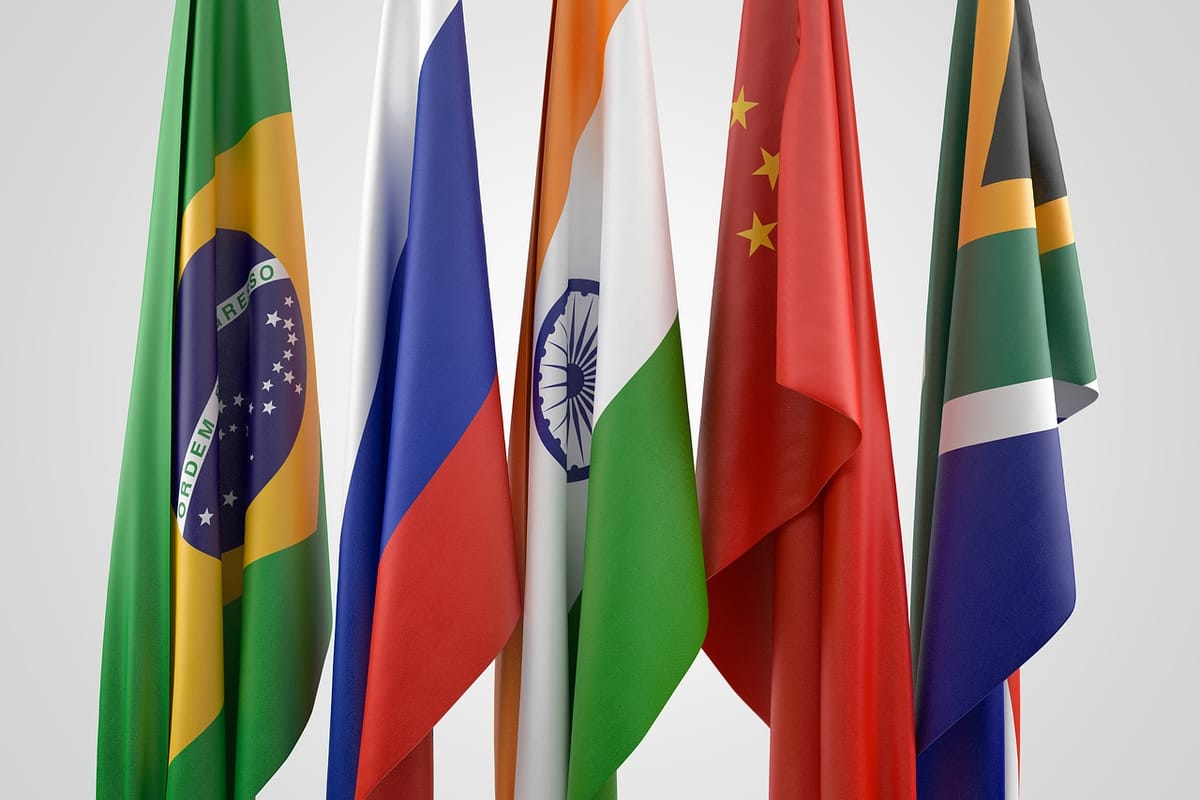
The bloc pitches itself as the future of multipolar order, yet beneath the solidarity brand, unresolved rivalries keep pulling it apart.
When the leaders of Brazil, Russia, India, China, and South Africa gathered in Kazan this August for the annual BRICS summit, the communiqués were confident: de-dollarization (more on that later), reform of global institutions, and a bigger tent under the BRICS+ banner. The bloc has cast itself as the voice of the Global South, counterweight to a somewhat tired-looking G7 and proof that a multipolar order has, in fact, arrived. South Africa’s president even framed BRICS as an architect of that world, not merely a participant (DW).
Look closer, however, and there are discernible cracks in the wall. BRICS has size, symbolism, even relative diversity, but it lacks cohesion. The members share a stage; they do not share a strategy.
The expansion that multiplies veto points
The 2023 expansion in Johannesburg, which invited Egypt, Ethiopia, Iran, Saudi Arabia, and the UAE, supercharged the BRICS brand. On paper, the enlarged grouping now represents nearly half the world’s population and more than a quarter of global GDP (CFR). Its New Development Bank (NDB) promises an alternative to Western lenders (South China Morning Post). The rhetoric is uplifting in tone: global governance reform, more local currency trading, and parallel pipes for finance.
However, expansion also multiplies the potential veto points, especially when members have issues that predominate. Adding Gulf monarchies, an oil-sanctioned Iran, a water-stressed Ethiopia, and an Egypt in fiscal dire straits does not produce a common agenda; it produces competing ones. So, a larger tent leads to more carefully worded communiqués and a shallow common denominator.
China and India: the defining fracture
The most consequential fault line is the one between Beijing and New Delhi. Shortly before the October 2024 BRICS summit in Kazan, the SCO summit in Astana once more placed India and China at the same table, underlining a diplomatic choreography that, from afar, looks to be cooperative. In practice, the India–China border remains militarized, with disengagement talks stuck and trust often wearing thin. The rivalry is not so much episodic, rather, it is strategic, and runs through supply chains, technology policy, and regional influence just as much as it does along the Line of Actual Control.
That rivalry plays out inside BRICS with differing expectations from both sides. China favors rapid BRICS+ expansion, deeper institutionalization, and de-dollarization, all mechanisms that nudge members toward a China-centric financial stack. India, however, is more cautious. It wants the promise of multipolarity to mean the dilution of any single pole, especially China’s, and not to crown a new one.
This is why New Delhi experiments with rupee settlements and hedges across forums, including the G20 and SCO, but resists anything that looks like an open alignmentunder Beijing’s umbrella. The outcome is visible in the communiqués: big on rhetoric, hazier on the specifics.
Russia: indispensable, yet dependent
Russia used to be the strategic glue, a power with global reach and one that played the balancing role between China and India. Now, under sanctions and with deepening economic reliance on Beijing, Moscow needs BRICS more than BRICS needs Moscow. The Kremlin leans on the bloc to signal its relevance and stability: energy corridors, defense industrial talk, and currency workarounds feature heavily in Russian talking points and say “we are not isolated”.
That emphasis, however, warps the BRICS agenda, crowding out other organizational priorities and forcing awkward silences from members who do not want to inherit the geopolitical costs of the elephant in the room: Russia’s war. The net effect, as analysis has argued, is that Russia’s position in BRICS is increasingly defined by its dependence on China, rather than exerting its own independent influence within the bloc (Carnegie).
Brazil and South Africa: autonomy with limits
Brazil under Lula talks a compelling game of strategic autonomy: elevate the concerns of the Global South, reform the IMF and World Bank, and move away from the central position of the dollar. However, Brazilian trade and finance are still tightly entwined with Western markets, and Brasília often tries to split the difference in language, supporting reform, yes, but avoiding explicit alignment with Beijing. South Africa, conversely, plays host and bridge: it champions inclusion and African priorities but lacks the economic credentials and impact to anchor the bloc’s agenda.
Both nations are essential to the brand, this is clear, yet neither can actually force convergence.
De-dollarization: more slogan than system?
This is the rallying cry: de-dollarize! Shifting the balance of economic orbit by settling more trade in local currencies, building alternatives to SWIFT, and scaling the NDB as a credible lender. However, the practice lags behind the promise. Local currency settlements remain small, often bilateral (think the India–UAE rupee–dirham or China–Brazil yuan settlements), and subject to convertibility constraints and questions around liquidity.
To counter this, a “BRICS currency” is talked about, yet this feels far more a pipe dream than it is technically or politically feasible. The NDB lends, but in modest volumes compared with the established Bretton Woods institutions. When countries face real balance-of-payments crises, they still go to the IMF. (Carnegie).
None of this means de-dollarization is a mirage; it simply means that, right now, it is incremental. The dollar remains the world’s operating system; BRICS is writing plug-ins, not a replacement.
Climate finance and resource politics: brittle solidarity
On climate, BRICS calls for more financing, opposes unilateral carbon tariffs, and positions itself as a champion of climate justice. The problem, though, is internal. China is both the largest emitter and a clean-tech powerhouse; India is expanding renewables at speed while still adding coal; Brazil grapples with deforestation and green reindustrialization; Russia’s export model is a one-horse show, utterly carbon-heavy; and South Africa lags, needing significant transition finance to start realistically moving beyond coal. The common denominator of “more climate finance, fewer trade barriers” is easy to state, somewhat more challenging to translate into joint action.
Resource politics add another layer. Members don’t just coordinate, they compete for markets in minerals, energy, and green tech. The lithium triangle’s tussles over value capture, Indonesia’s nickel downstreaming, and Gulf financing of clean hydrogen all intersect with BRICS ambitions. Every push for “south–south” supply chains beaches itself on the shores of a basic truth: everyone wants to climb the same value chains at once.
The SCO overlap: optics vs. outcomes
The Tianjin SCO summit was a useful prelude to Kazan. It showed the same pattern: optics of cohesion, outcomes of caution. India attends both SCO and BRICS, projecting autonomy and reach; China uses both to normalize its leadership in non-Western forums; and Russia seeks legitimacy by association. The SCO’s consensus rule and the presence of India and Pakistan, however, keep the texts bland and initiatives ever thinner. It’s useful to note that BRICS has no consensus rule on paper, yet the politics of keeping everyone in the tent and seeming to be happy for it has a similar effect.
The lesson from both forums is the same: visibility matters; specifics stall.
What BRICS actually is (and isn’t)
BRICS is not a bloc in the classic sense. There is no common defense pact, no integrated market, no shared currency, no institutional enforcement that lends regulatory weight. It is both a stage and a signal: the stage being where leaders rehearse the language of a post-unipolar world and demonstrate relationships that bypass the West; the signal being advising third countries that there are now multiple rooms to enter, not just one, and BRICS is one such room.
That stage still matters, since forums structure attention and create the regularizing habits of diplomatic contact. They also normalize the notion of alternatives. A stage, though, and it must be said, is not a system. What multipolarity does is multiply the opportunity to bargain, it does not imply an automatic alignment. It should be noted that, in BRICS, bargaining is the point.
The Global South and the redistribution of choice
If you strip away the communiqués, the ebullient language, the chirpy messaging, what remains is the redistribution of choice. Countries may now discover they have parallel channels to explore, rather than facing a binary world in which their choice structure was either to work with Western-led institutions or not at all. They can borrow from the NDB, test local currency trades, or use BRICS+ to court investment and attention, all useful leverage, for sure. However, this does not, by itself, produce the real impetus of development, resilience, or coherent rules.
For readers tracking the broader fracture of the global order, BRICS is a case study in poly-alignment as lived reality. Members sit in multiple rooms (G20, SCO, BRICS, regional forums), keep options open, and resist hard alignment. The cracks at the core, especially the China–India rivalry and Russia’s dependence, define the current ceiling on what BRICS can do together.
Multipolarity is here. Unity, not yet. And while that may be enough for a while; it will not be enough forever.
Read this. Notice that. Do something.
Read this: South Africa’s framing of BRICS as an architect of multipolar order (DW); AP’s clear explainer on the BRICS expansion (AP); a concise statement of reform rhetoric from the 2023 summit (CFR); why Russia’s position inside BRICS increasingly hinges on China (Carnegie).
Notice that: expansion increases veto points; climate finance solidarity fractures on contact; and de-dollarization, for now, is incremental and uneven.
Do something: when you see “BRICS consensus,” check the specifics: whose trade is actually settling in local currencies; which projects the NDB is financing; and where India and China’s border politics quietly veto grand designs.
Previously on GYST: France’s African retreat: who fills the vacuum?
Next up: Power Transit: The New U.S.–India–Gulf Triangle.