
Asia’s supply-chain pivot: from ASEAN enlargement to the new industrial map
ASEAN’s enlargement and upgraded trade deals are turning Southeast Asia into the new workshop of global manufacturing. Between U.S. friend-shoring and Chinese industrial outreach, a rebalanced regional economy is taking shape.


When Timor-Leste raised its flag alongside ten others at this year’s ASEAN Summit, held in Kuala Lumpur in October, it marked more than a diplomatic milestone. The bloc’s newest and smallest member became a symbol of Southeast Asia’s increasing gravity, its pull on the global economy. And, as the United States and China busily grab the headlines by competing to secure the industries of the clean-energy age, ASEAN’s network of free-trade deals and investment corridors is subtly redrawing Asia’s industrial geography.
What began as a political project for regional peace is now a workshop for a new supply-chain order: enough integration to attract both superpowers, yet self-confident enough to chart its own course.
A new member, a wider map
Timor-Leste’s accession, the first enlargement in two decades, is the minnow joining the bigger school of fish, adding a modest economy of 1.4 million people to ASEAN’s $3.8 trillion market. The point is one of inclusion, and the country’s leaders called it a “historic moment of belonging,” while ASEAN officials cited it as proof that the bloc is still growing and is in no way exclusive. Now, the practical work can begin: the tricky task of aligning hundreds of regional agreements and building the infrastructure to stitch together production networks that stretch from Yangon to Manila, across 11 states, 4.5 million square km, and 700 million people.
For ASEAN itself, the new addition carries a signal. At a time when other regions are fracturing, Southeast Asia is expanding its brand, its institutional reach, and investing in the physical infrastructure, ports, digital backbones, energy links, that will pull its eastern frontier into the same value chains powering Vietnam and Indonesia. This aims to reinforce ASEAN’s claim to “centrality” in regional trade governance: a multi-nation market positioned between the rival systems of India, East Asia, and Australia, yet beholden to none.
Greener, smarter trade
And what about those trade agreements? Well, behind the overt symbolism, a dense web of new regulatory activity is taking shape, the most consequential of which is ASEAN–China FTA 3.0, the latest version ‘upgrade’ signed at the summit, which expands the 2010 pact with chapters on digital trade, green technology, and supply-chain connectivity. Bilateral trade already topped $770 billion last year, and both sides framed the deal as necessary insulation against the new wave of U.S. tariffs, a framework for “future industries.” Quite positively, Singapore’s prime minister Lee described it as a bridge between today’s manufacturing strengths and tomorrow’s clean-tech ecosystem.
The agreement complements RCEP, the world’s largest trade bloc, by adding rules on data and low-carbon cooperation that RCEP’s first iteration lacked. Analysts note, somewhat wryly, that together, the two frameworks create “a buffer against protectionist headwinds,” weaving Asia into a web of flexible interdependence that lets firms re-route production without leaving the region. For example, a Malaysian solar panel maker can now import Chinese cells, tariff-free, assemble them locally, and export finished modules across ASEAN. This is a model spreading across EV batteries and electronics as well, effectively providing a commercial network that reduces external (read: U.S.) dependencies, improves the chance for resilience, and tilts the poles of economic power further toward the region.
Beyond China, the grandly titled Comprehensive and Progressive Agreement for Trans-Pacific Partnership (CPTPP) continues to attract new membership and investment: Vietnam, Malaysia, and Singapore use it to reach Western markets with higher environmental and labor standards, helping in turn to upgrade domestic standards. Vietnam’s position is particularly strategic: it now sits at the crossroads of CPTPP, RCEP, and the EU-Vietnam FTA, offering a position of reliability that has drawn major reinvestment from Samsung, Foxconn, and a growing list of renewable energy manufacturers (Vietnam Government News / Nikkei Asia).
The U.S., even as it deploys new waves of tariffs, is also testing a different model through the Indo-Pacific Economic Framework (IPEF). Its 14 members have signed a Supply Chain Agreement to coordinate on disruptions and set shared standards for labor and sustainability. Linked to the Minerals Security Partnership, which funds nickel, lithium, and rare-earth projects across Southeast Asia, these efforts complement Washington’s protectionism by embedding resilience and values into the wiring of global production. The paradox, of course, is that a strategy framed around openness and cooperation now advances under the shadow of Washington’s unilaterally imposed trade walls.
This Substack is free, three times a week, but I’d still love it if you subcribed!
The race to secure supply chains
Beneath the legal language lies the single most titanic struggle, the aforementioned U.S.-China tussle for industrial influence. Beijing’s strategy is to ensure that, if the bilateral supply chain truly splits, China and ASEAN can form a self-reliant ecosystem that captures diversity in output, everything from semiconductors to solar cells. Its 2025 rare-earth export controls—briefly eased during the recent tariff truce with Washington—reminded the world how much of the green-tech transition still depends on Chinese processing capacity. To underline this, Beijing has since doubled down on regional partnerships, financing a new magnet plant in Malaysia and battery material facilities in Indonesia, both moves to tighten Asia’s green-tech loop around Chinese technology.
The U.S. strategy of ‘friend-shoring’ leverages its network of allied economies to build new supply chains while keeping China in check. To this point, recent U.S. deals with Thailand, Vietnam, and Indonesia on critical minerals seek to build an alternate sourcing network for EV batteries and electronics (Reuters) that reduces reliance on Beijing’s leverage. Combined with the Inflation Reduction Act’s local-content rules, those which tie U.S. subsidies to materials sourced from America or its trade partners, these accords give companies a financial reason to base production in Southeast Asia while still qualifying for U.S. incentives and avoiding tariff penalties.
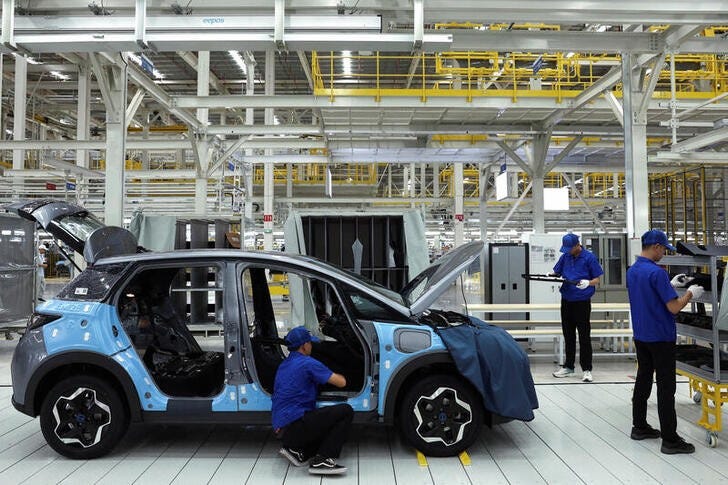
To understand what this all means in practice, look at the factory floors. Thailand, long an automotive hub, is switching through to electric vehicles, hosting both China’s BYD and the U.S.’ Ford EV plants under generous government schemes. Malaysia’s semiconductor sector, a hub of global chip assembly, is now expanding with Japanese and American investment to offset export-control risks. The result? Not a clean decoupling, perhaps, but a competitive layering of manufacturing ecosystems, both Chinese or Western-anchored, all across the same geography.
A new industrial map takes shape
The shift is measurable. Vietnam’s exports reached about US $405 billion in 2024, driven by electronics and machinery, while Indonesia’s stood near US $265 billion, sustained by refined metals and mineral exports. Taken together, ASEAN’s total merchandise exports were about US $1.95 trillion in 2023, accounting for roughly nine percent of global trade (OEC). Current trends are likely to push that figure toward US $2 trillion for 2024, once the numbers are confirmed. The steady expansion points to how supply-chain diversification and new trade frameworks are translating into tangible industrial gains across Southeast Asia.
And the new map? The emerging pattern, in many senses, is a flatter, more distributed Asia, with different regions broadly emerging to portray strength in certain sectors: Malaysia doubles down on chips and automation; Indonesia on nickel and downstream processing; Thailand on EVs; Vietnam on electronics; the Philippines on digital services; and Timor-Leste, the new minnow in the ASEAN pond, eventually and somewhat aptly, on energy and fisheries. China, of course, remains the region’s heavyweight, but with distribution comes a tangible softening of the hierarchy. “Made in Vietnam” and “Made in Indonesia” now sit comfortably alongside “Made in China” labels, and often on components of the same product.
For ASEAN governments, diversification brings both a step up in bargaining power and a tacit dose of risk. There are now competing courtiers: Washington, on the one hand, promising technology and access; Beijing, on the other, offering liquid capital and scale. These factors raise the promise of investment, sure, but also ratchet up the strategic pressure. Maintaining open doors to both sides has become a balancing act, a role most effectively played of late by India, and is grounded in deep institutional discipline: keep the markets open, avoid binary choices, and let integration itself act as the glue that stabilizes the near-term prospects. The trick is to ensure the discipline is in place.
Also undeniable is the decidedly green orientation of these supply chains, one which carries global significance. Asia already produces more than 70 percent of the world’s solar panels and most EV batteries, and spreading that capacity across multiple ASEAN economies can lower costs and further accelerate the energy transition. The real test, once more, is of discipline, of the coherence of regional governance. To effectively convert manufacturing growth into real sustainable development, ASEAN needs stronger environmental standards, circular-economy policies, and transparent carbon accounting, all goals now written into its newer trade chapters, but still unevenly enforced among its economically diverse membership.
What does this all mean?
The geography of production is still, in effect, the geography of power. As many supply chains reroute through an expanding ASEAN, the region is becoming both the hinge and the buffer of globalization’s next phase. For multinational firms, the lesson is clear: resilience now matters as much as efficiency. For policymakers, the region’s example shows that cooperation, not confrontation, can still yield growth in a polarized world.
We opened with Timor-Leste’s flag-raising, and if it seemed like a footnote, it was in fact a marker on a new industrial map, one that links the smallest economies to the frontiers of clean technology. The center of gravity in global manufacturing is shifting south and east, not by decree but by design, and Southeast Asia is rewriting the rulebook of how interdependence may flourish to survive rivalry.
Read this. Notice that. Do something.
Read this.
Vietnam Government News (via Nikkei Asia) shows how Vietnam has become the anchor of Japan’s “China + 1” shift, with production spreading along the Mekong corridor—evidence of supply chains migrating beyond China. Vietnam Government News / Nikkei Asia
For the parallel U.S. track, Reuters details Washington’s new trade and critical-minerals agreements with Thailand, Malaysia, Cambodia, and Vietnam—an explicit push to stand up non-China routes for rare earths and battery inputs. Reuters
And the ISEAS–Yusof Ishak Institute analyses how overlapping trade and minerals pacts are already reshaping ASEAN’s industrial base, turning incremental deals into a durable shift in regional power. ISEAS Perspective. And the Observatory of Economic Complexity (OEC) quantifies that shift: ASEAN’s combined exports reached about US $1.95 trillion in 2023, underscoring the region’s growing centrality in global manufacturing. OEC
Notice that.
A region once treated as the factory floor of globalization is now its moderator: mediating between rival systems, setting standards for green production, and proving that strategic autonomy can come from interdependence rather than isolation.
Do something.
Watch the trade corridors, not the summits. It’s in these supply-chain junctions, the ports, refineries, data routes, where the architecture of the clean economy is being drawn, and where the balance between resilience and rivalry will be decided.
Previously on GYST: Tariff truce or tactical reset? What the fragile U.S.–China thaw signals for global governance
Next up: The next great test of democracy: governing a warming planet.